After taking some in college, philosophy to me was more like a stepping stone in critical thinking to embracing the light of science. I've noticed on so many youtube forums for example, people postulate things without external verification in nature, "if this then that" where tautologies and vin diagrams and the like are held as absolute truths. It never was sold on that as there are more dimensions to reality than our simple minds can grasp within a cleverly worded statement.
The main point being is observing nature always trumps anything philosophy will ever invent on its own. Philosophy is a nice way to help frame hypothesis if you keep in mind that's all it can ever do and not take it too seriously. I do give philosophy the proper respect it deserves for starting the fire of thinking deeper so I could grasp what quality information actually was, but then you must step off of it as something unreliable unto itself.
Yes, absolutely. As an extreme example, we also started from lower versions of apes as well but we keep progressing and refining. To quote Marvin Minsky, "We stand on the shoulders of giants, but we should also know when to get off." when he was referring to philosophy in particular.
Science can certainly be an interesting pastime, can provide lots of interesting and intellectually stimulating results, is arguably responsible for the technical advances we see around us, and you're likely to make more money and get more respect as a scientist than as a professional philosopher, but how much we're learning about the wold through science is very much open to debate.
For one, the scientific study of perception itself (not to mention the study of chemistry and physics) brings in to question how much of what we perceive is real. The solid-seeming table not really being at all as solid as it seems, or the small trees in the distance not really being small being some of the commonest and simplest examples. There are plenty of other examples, from optical illusions to a wide variety of phenomena detected through experimental aparatus but not usually available to our senses, such as x-rays, viruses, and so on.
Such phenomena and the stories scientists use to explain them have lead to the widespread questioning of the reality of the world as we commonly experience it, and even to questioning if the world itself is a simulation -- questions from physicists, no less. These are philosophical questions, but ones I'm not convinced that science is equipped to answer. I'm not sure what experiments could ever be performed to determine whether ultimately, deep down, whatever scientific instruments detect or theories postulate is "really real" or just illusion. At the most basic level, it's questionable whether science ever even "gets closer to" some kind of ultimate "truth", or whether they're always just attempts to explain mere apperances.
There are many other objections to the claim that science is the only true, valid, or legitimate way of acquiring knowledge, and to the claim that scientific results are either true or approaching truth. But I'll spare you in the interest of not making this post in to a book or boring you any more than I already have. I'll just point to you these articles on Skepticism[1], Epistemology[2], and Scientism[3] and move on to pointing out that even were we to grant that the practice of science gives us access to truth, there are still some realms off-limits to it, such as (more specifically) ethical questions, and more generally telling us how we should act when given a choice. There are no experiments which can be performed that can show us which is the "right", "moral" or "ethical" choice in any given situation. One could certainly survey some population, but that would only tell you what some people think is right, moral, or ethical, not what actually is (unless you think what the majority believe must be true, which is yet another philosophical position and up for debate). So this is yet another example where science just stands mute, and I don't see any way it'll ever be able to speak on these subjects.
I think most well educated scientists realize these limits of science, and consequently don't make grand claims for the Truth of what they're discovering or the superiority of science over other fields. In fact, those subjects and such claims are off-limits in most if not all scientific journals. It's outside scientific journals, and one could say outside of science proper that such claims are heard, and they're often made either by science fans who are not scientists, or by scientists who really haven't studied the philosophy of science much and get a little too carried away with the popular view of science.
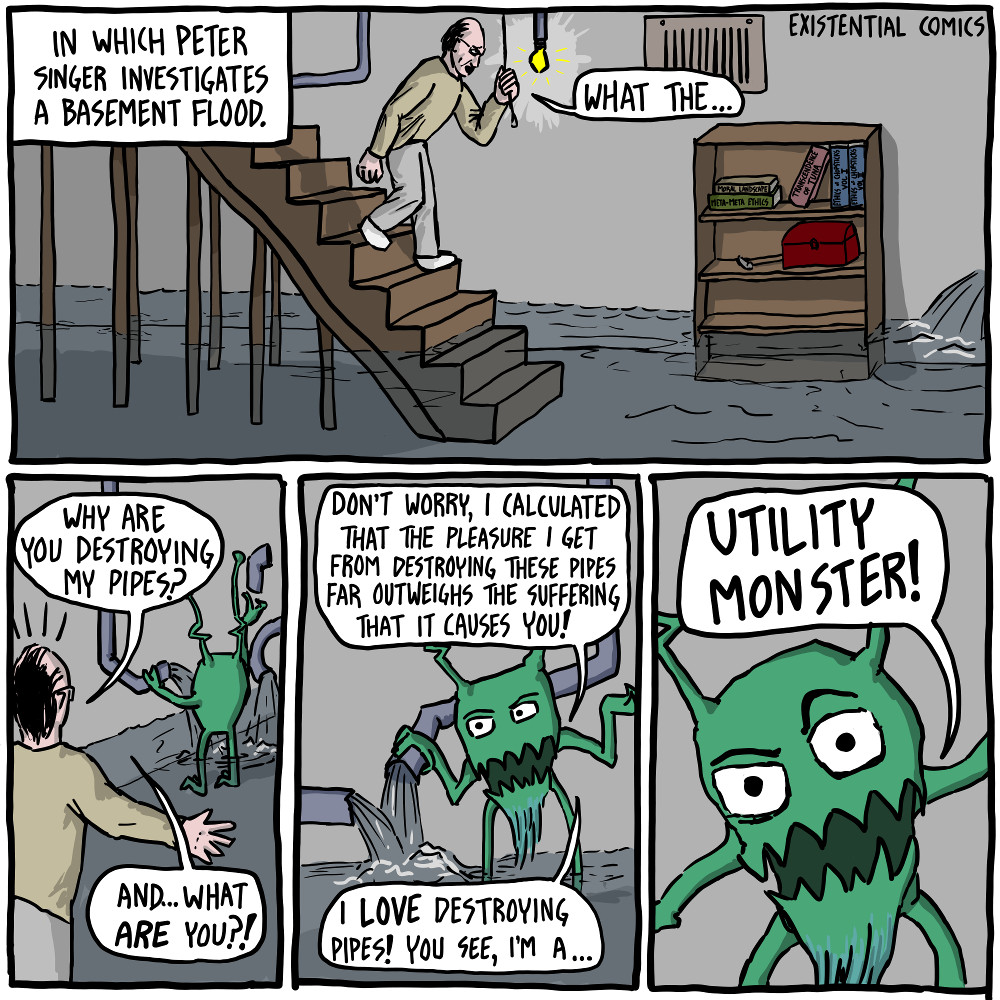
I noticed you failed to mention utilitarianism, which asserts that there is no better guiding principle for ethical choices than the greatest potential well being (or happiness) of all affected sentient individuals. [This is the one Sam Harris gets accused of 'ripping off' without mentioning it by philosophy types who dislike him.] I've heard and read a whole lotta bluster from people who have nitpicky issues with it, but I find it pretty satisfying.
That is wondrously hilarious. I am saving it, thank you.
Yes, there are some good counter-arguments (such as the one the comic refers to), but in my mind they more indicate potential pitfalls that need to be discussed and worked around rather than completely destroying the theory.
Most of this stuff doesn't translate into real world scenarios effectively regardless, I look at it more as helping guide complex decisions which have to be made in a chaotic and fast moving world that is difficult or impossible to reduce down to pure data.


The main point being is observing nature always trumps anything philosophy will ever invent on its own. Philosophy is a nice way to help frame hypothesis if you keep in mind that's all it can ever do and not take it too seriously. I do give philosophy the proper respect it deserves for starting the fire of thinking deeper so I could grasp what quality information actually was, but then you must step off of it as something unreliable unto itself.