Most people stop reading something after the first few sentences. In that crucial 10 to 15 seconds, a book (or essay, or article, or blog post) has to make, and win, a subconscious appeal to your attention. Your reader's attention span is like a snotty doorman at a hot club. Your opening sentence needs to grab his interest and sneak the rest of the piece into the door.
Consider the following examples from fiction:
"It was a bright cold day in April, and the clocks were striking thirteen." --George Orwell, 1984
"It was a pleasure to burn." --Ray Bradbury, Fahrenheit 451
"As Gregor Samsa awoke one morning from uneasy dreams he found himself transformed in his bed into a gigantic insect." --Franz Kafka, The Metamorphosis
Or these examples from nonfiction:
"Air-conditioned, odorless, illuminated by buzzing flourescent tubes, the American market doesn't present itself as having very much to do with Nature." --Michael Pollan, The Omnivore's Dilemma
"I like to take my time when I pronounce someone dead." --Jane Churchon, "The Dead Book"
"Out of nowhere I developed this lump." --David Sedaris, "Old Faithful"
This is not to suggest that opening lines should be pure gimmickry, or that they should be conceived entirely apart from the rest of the piece itself. Provocation for provocation's sake is a game of diminishing returns. Rather, the opening line should immediately intrigue the reader by establishing a compelling tone -- one that the rest of the work will follow.
Compelling does not necessarily mean brief, though in modern practice, the two are frequently corelated. That being said, some of the best opening lines in literary history are long and winding. The key is setting up intrigue, however many words that may take.
To my knowledge I don't know anyone who picks up novels, reads the first few sentences, then throws them away. Maybe people do this in airport bookstores, but I don't think Orwell, Ray Bradbury, or Kafka wrote with the ADHD audience in mind.
On the other hand I know that many readers hate to put a book down without giving it a fair shot.
The "catchy opening" design pattern is present in a lot of art where the audience has almost no chance of leaving, like Beethoven's 5th Symphony, or that famous opening shot with the star destroyer in "Star Wars". It's an artistic effect. Conversely, the "Harry Potter" novels have a mundane, slow first few chapters, and they did pretty well.
Actually, I think Harry Potter has a pretty strong opener:
Mr. and Mrs. Dursley, of number four, Privet Drive, were proud to say that they were perfectly normal, thank you very much. They were the last people you'd expect to be involved in anything strange or mysterious, because they just didn't hold with such nonsense.
"To my knowledge I don't know anyone who picks up novels, reads the first few sentences, then throws them away. Maybe people do this in airport bookstores, but I don't think Orwell, Ray Bradbury, or Kafka wrote with the ADHD audience in mind."
Browsing is (was?) incredibly common in the bookstore era, and will become even more so in the modern era and beyond. Especially as digital sampling becomes more prevalent, and as the barrier to entry (price) comes down significantly. If anything, we'll see even more buy-and-then-browse behavior. And for what it's worth, book returns were prevalent in the heyday of the B&M bookstore, and they're a significant factor in Amazon's business to this day. (In fact, I'm willing to wager that quite a few people, even the highly literate ones, haven't read the majority of the books sitting on their shelves.)
Regardless, I'm not talking about the opening line as a sales proposition. I'm talking about the opening line as a gambit to get someone to keep reading when they first pick up the piece. How many times have you bought a book, or picked up a magazine, or clicked open a blog post, and simply lost interest after the opening paragraph? I'm not saying you immediately regret picking it up, but rather, that you think to yourself "Meh, I'll skip this one and read something else. Maybe I'll come back to it later." This behavior is pretty common, and by nature, the human attention span in limited. In no way am I talking about the "ADHD audience" here. I'm talking about basic human wiring.
As for Kafka, Orwell, et al., bear in mind that their initial audience was a reader at a publishing house, journal, or newspaper. Oftentimes, your first target reader is the one who decides whether or not to publish you in the first place. This person reads thousands of pieces a week, and getting his or her attention has been a crucial task since the invention of the printing press.
I think most novelists write with the intent to be read after they have some years of experience. It's the next, natural step. Whether that reader is at a publishing house or not is a little hard to know, especially in Kafka's case.
From what I've read and studied at university, Kafka wrote for his friends a lot. He shared his writings with them and they had a laugh. His pieces were known (by his friends) as dark comedies. Whereas in Western Europe and North America, they are read as existential pieces.
Kafka doubted many times that his novels and stories would ever be published because of their 'immoral' content. So, I'm interested in any further info you have that might suggest otherwise.
"Kafka doubted many times that his novels and stories would ever be published because of their 'immoral' content. So, I'm interested in any further info you have that might suggest otherwise."
To be frank, the subject of Kafka's authorly intent or personal inclinations is a bit tangential to my original point, and I'm not sure how we arrived here. I can tell, by your username, that Kafka is a subject of great personal interest. I share a love of his work, though I do not have any particularly privileged or scholarly insight into his history. I simply brought his name up because he wrote a great opening line to a great work, and because he wrote in an era in which readers' attention spans were every bit as precious as they are today.
I think my original point has been sidetracked: namely, that great opening sentences capture the reader's attention, and that the reader's attention is at a premium. That's the only point I ever set out to make in this thread. And I think the point remains valid.
Those opening sentences have a particular kind of urgency. By contrast, the equally memorable openings of Lolita and Moby Dick could never be called urgent, but they do instantly establish an unusual first-person narrator. What they all share is density. If instead you want to fill up the page with ink while wasting the time of your readers, you start your book like Dickens did in A Tale of Two Cities.
Lolita, light of my life, fire of my loins. My sin, my soul.
and
Call me Ishmael.
and
It was the best of times, it was the worst of times, it was the age of wisdom, it was the age of foolishness, it was the epoch of belief, it was the epoch of incredulity, it was the season of Light, it was the season of Darkness, it was the spring of hope, it was the winter of despair, we had everything before us, we had nothing before us, we were all going direct to Heaven, we were all going direct the other way - in short, the period was so far like the present period, that some of its noisiest authorities insisted on its being received, for good or for evil, in the superlative degree of comparison only.
The old joke about Dickens is that he got paid by the word, and he wrote accordingly. (There's probably some truth to it; he did serialize many of his novels, and was paid by the word for them. But he was paid very handsomely, and was considered something like his day's equivalent of John Grisham or Stephen King. It's doubtful he was seriously trying to nickel and dime his publishers by being verbose).
That said, I quite enjoy that opening line. It's satirical and snarky, and it plays on the sort of common hyperbole that's still very prevalent in today's society.
Dickens wrote many great sentences by my reckoning, but that one has always annoyed me. It is a workaday piece of prose that long overstays its welcome, finally admitting its own irrelevance to this or any other book. That punch line witticism is an insufficient excuse for its pride of place as a starting sentence.
> "It was a bright cold day in April, and the clocks were striking thirteen." --George Orwell, 1984
I think I've frequently heard this called a great opening line, and I've never worked out why. It doesn't tell me anything that I care about, it doesn't seem especially clever, and I don't notice myself having any other discernible emotional reaction to it.
In addition to the excellent points others have made, the description "bright cold day in April" is filled with strong contrast. April is usually a warm month or, at worst, cool. It isn't typically cold. Similarly, bright days tend to be more warm than not so sunny days. So it strongly evokes unusual weather, which has a long history of being associated with abnormal events of significance to humans.
This is part of why the weather is a popular topic and something modern humans have put substantial effort into predicting, broadcasting, etc. The opening line signals an atmosphere ripe for unusual, important events that you wouldn't typically expect. It is a means to suggest the calm before the storm without admitting directly that a storm is coming. It is the kind of thing which causes one to prick their ears up, a cross between curiosity and threat assessment.
Real life examples: The year Krakatoa exploded, there was enough ash in the air to cause an abnormally cold summer in Europe. (This cold summer led to a story writing club which resulted in the original "Frankenstein". It was too cold for normal outdoor summer activities.) The night of the 1906 San Francisco earthquake, people were manic and still up after midnight when the quake finally hit. And stories of historical (pre modern weather prediction) weather disasters typically start with comments on the unusual atmosphere which weirded people out beforehand but failed to tell them exactly what was coming.
So I think the line evokes that sense of being on edge and expectant even though you aren't quite sure why because there is no explicit threat inherent in a bright cold day in April. Still, there is implicit threat of something coming that you can't quite put your finger on. When it was written, people were likely more in touch with the weather than a lot of people in developed countries today, so it would have been more strongly evocative for that audience.
The word 'April' tells us it's a time and place similar to today.
Clocks striking thirteen tells us it's somewhere different.
Thirteen is a traditionally unlucky number.
It's a classic science fiction method of establishing setting. We're someplace similar to today but a little different, all transmitted in very few words. The effect is a tiny bit unsettling... if they changed the clocks to chime on thirteen, what else is wrong?
It's similar to Heinlein's famous way of indicating we're in the future in a single line: "The door dilated."
It sets the scene really well: "A bright, cold day in April" is evocative of exactly that. It's not pretentious and it immediately puts a setting in the readers mind.
"and the clocks were striking thirteen." is an immediate juxtaposition of something non-intuitive. The first reaction is "Clocks don't strike thirteen! They strike a maximum of twelve!". It's just nonintuitive enough without necessarily being obviously nonsense. And so the reader is engaged to read the next sentence to find out what he means by thirteen. Get the reader to read the next sentence enough, and you've tricked them into reading the book ;-)
My first reaction is more like "okay, so it's one o'clock". I never really noticed that it was weird before, though now it's pointed out I can see that it is.
The 24 hour clock is still not universally adopted in the UK. No English speaker says says "thirteen O'Clock" the way one might say "treize heures". English speakers might say "thirteen hundred hours", but only in restricted circumstances (e.g. in the military).
I think the point of the first line isn't to say anything, be clever, or to give you an emotional reaction. It's to prompt questions that make you want to read further. Questions like:
* Why is it a cold day in spite of the fact that it's spring, and bright out?
* Why are the clocks striking thirteen? Did the earth's rotation become slower? Or did some bureaucrat change the system of time to match his whims?
In my mind, it alludes to the fact that this is a world that is ok with blatantly inconsistencies, but forces you to verify that allusion by reading further.


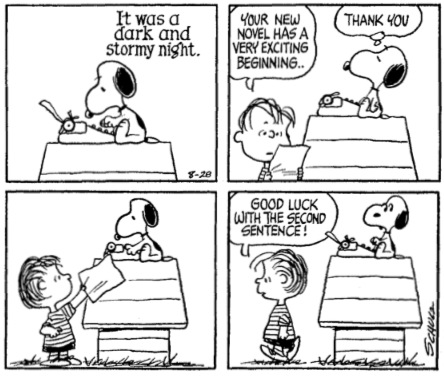
Consider the following examples from fiction:
"It was a bright cold day in April, and the clocks were striking thirteen." --George Orwell, 1984
"It was a pleasure to burn." --Ray Bradbury, Fahrenheit 451
"As Gregor Samsa awoke one morning from uneasy dreams he found himself transformed in his bed into a gigantic insect." --Franz Kafka, The Metamorphosis
Or these examples from nonfiction:
"Air-conditioned, odorless, illuminated by buzzing flourescent tubes, the American market doesn't present itself as having very much to do with Nature." --Michael Pollan, The Omnivore's Dilemma
"I like to take my time when I pronounce someone dead." --Jane Churchon, "The Dead Book"
"Out of nowhere I developed this lump." --David Sedaris, "Old Faithful"
This is not to suggest that opening lines should be pure gimmickry, or that they should be conceived entirely apart from the rest of the piece itself. Provocation for provocation's sake is a game of diminishing returns. Rather, the opening line should immediately intrigue the reader by establishing a compelling tone -- one that the rest of the work will follow.
Compelling does not necessarily mean brief, though in modern practice, the two are frequently corelated. That being said, some of the best opening lines in literary history are long and winding. The key is setting up intrigue, however many words that may take.