Teenage Engineering is a frustrating company. On the one hand, they set out to create some of the most fun music equipment you can own: their Pocket Operator line is awesome for beginners of the hardware world, and they've consistently innovated with their grooveboxes. The problem? They have absolutely no respect for their pricing model. The OP-1 used to cost $800, which was already a big ask for a microprocessor, OLED screen and plastic enclosure. A great machine, but a hard to swallow price to be sure. Once YouTubers started picking up on them, they chose to increase the price (blaming it on a supply shortage, since we all know how hard it is to find ARM cores and OLEDs /s), leaving the OP-1 at a bewildering $1100 total.
If you, the reader, has $1100, pick up an Octatrack. Elektron is one of the few companies that pushes the envelope of digital sequencing and hardware production, and the Octatrack is the pinnacle of their work. At $900-1000, you'll definitely get more mileage out of it than an OP-1, and you don't have to support Teenage Engineering's shitty pricing schema. Even at $600, you can buy an Elektron Digitakt/Digitone, which will probably serve you better in the long run.
>The OP-1 used to cost $800, which was already a big ask for a microprocessor, OLED screen and plastic enclosure
I'm not sure it makes sense to price a hardware product on it's BOM. This kind of thinking is what leads to most hardware being absolutely crappy. Good product designers need to be paid, and design choices don't show up in the BOM. The same goes to hardware.
When I see an ARM chip and an OLED screen going for $$$, the calculus in my mind is I'm actually paying for engineering and design labor, not a BOM.
This is top down pricing. Multiple engineers clocked a considerable amount of time on this project. The number of OP-1s sold probably numbers only in the low tens of thousands. It's priced appropriately considering how many they're going to sell and the value the device provides (and not just the raw material cost).
We do a lot of computer programming using free or cheap (and billed monthly) tools on this site, so it's really easy to forget that professionals in other fields will pay a premium for something that works with minimal fiddling. Watching electrical engineering managers dump tens of thousands into single pieces of test equipment to not have to fuck around with patchwork solutions is enlightening, and I think software developers would do that a lot more if the FOSS route wasn't the only thing they knew.
I bought my OP-1 at a steal for $600 two years back. I'd pay $1200 for it today, maybe $1600.
There's a lot of more technically capable stand-alone gear that can be had for less of course. My MPC Live is what my finished (not good compared to others, I'm just an amateur making video game soundtracks for kids I teach game dev to) songs ultimately come out of, and the Octatrack is something I've really enjoyed playing with. None of these are going to be something that lives in my backpack and comes out in the park on a sunny day when I've got that perfect boss battle intro sequence drop popping into my head though. Size considerations aside, I can slam down a decent prototype of a song that's actually listenable in just a couple of minutes on the OP-1 before the idea fades away, and have a blast doing it.
I think their pricing is sensible. The thing fills a niche no other piece of gear I've found can. That seems worth paying for.
Yeah, I absolutely love my OP-1. Drum machines, synths, everything I need for sketching out ideas anywhere I might happen to have some free time. Before the Lost Year, it was great to bring on trips: You can do some great stuff on an airplane.
I believe George Harrison said the ukulele is the best instrument for songwriting - it's portable, self-contained, and incredibly easy to work with. The OP-1 hits a similar spot for me: It's a bicycle for songwriting.
I bought a used one a little while back - because I wanted to try it out and I found one at a price where I knew I could re-sell it easily. I fiddled around with it periodically, and it was fun, and with my limited skills I could do something that sounded reasonably musical with it. But - a. No proper MIDI implementation and b. I found the synth engines very frustrating.
On the other hand, using it as a way to add backing to my sax playing, and record my sax onto the device was fun.
But I got rid of it, and bought a used organellem and plenty of change left over (with which I might buy a proper sequencer at some point, but maybe not).
I've currently got a Novation Circuit which I bought on the same idea. Because I play a lot of acoustic music the circuit seems definitely not for me, but again it's kind of fun and has a nice shallow learning curve.
I agree; I tried standalone boxes like the Electribe 2 and Circuit, and the iPad with Korg Gadget is just way more flexible and quicker. The soft synths available are truly equal to desktop apps now. DAWs like Cubasis and Aria are way more powerful than the OP-1s abilities, although I still feel like the workflow could be improved.
Sorry for the meta-discussion (which I know is against the guidelines), but I'm finding it really hard to respond kindly to your comment, given the overarching tone ("no respect", "hard to swallow", sarcasm about parts, "shitty pricing"). I'd love to engage with you on the merits of pricing for what the market will bear, CoGS including software and craftsmanship, etc, but I am not able. Perhaps that's my failing, but I'd like to encourage you to be less acerbic in the future.
If my tone comes off as "acerbic", I guess I'm a little surprised. I love Teenage Engineering (and own a few Pocket Operators too), but I gotta call them out on the pricing issue here. When the price of the OP-1 did start to skyrocket in 2012, Teenage Engineering said absolutely nothing, and then discontinued it in 2013, sending the secondhand market soaring again. Of course, their response is to put it back into production at a higher cost, for more customers. You can slice this any way you want, but there's not really an excuse for an all-digital synth to increase in price like that. I have no doubts that a simple redesign could bring the BOM down to sub-$200, even in 2015. Failing that, they could have taken the re-release as an opportunity to fix some of the issues in the original model: give it a sensible charging port, improve the microphone quality, or even improving the sample transfer software. None of these issues were ever addressed. The insult added to injury is the OP-Z, a "successor" that was designed to be inferior to it's predecessor, as not to cannibalize it's market.
Maybe I am hateful, but Teenage Engineering has definitely had a fall from grace. Even their recent modular kits left a bad taste in my mouth...
There are schools of (microeconomic) thought that would encourage them to raise prices even further in order to reduce demand to match their supply capability. If the second-hand market prices a good higher than the original seller, that's a very clear signal to increase the price. At least that way the profits end up in the manufacturer's pocket (which they can use to increase volume) instead of a speculator's. That is all to say, their raising prices is ethical, legal, and moral.
You seem to be seeing something nefarious in their discontinuing the OP-1, and then re-continuing it at a higher price. Even absent the above, it makes perfect sense that they could be losing money on a product, and then re-introduce it at a higher price so they stop losing money.
Now, should they have been losing money at the lower price point? You talk a lot about CoGS, but that completely neglects things like design and development time. The OP-1 is, by all accounts, extremely well-designed and built. Economies of scale let companies like Apple pick lower margins because that R&D time is amortized over a huge number of devices manufactured. Boutique operations can't do that.
All that still ignores squishier questions like choosing to keep a price point in order to fund other projects (that may never be built) with increasing margins over time, or hell, I dunno, paying bigger bonuses to employees. Clearly people are willing to pay it, and they're under no obligation to price their goods according to any objective thing at all. Maybe the CEO is a mystic and likes the numerology of the new price better.
> You seem to be seeing something nefarious in their discontinuing the OP-1, and then re-continuing it at a higher price.
This is typical behavior of a certain large class of musicians, particularly electronic ones.
The message boards are full of people complaining that these companies charge "too much." They will also then complain that Behringer sucks for "stealing" ideas and pricing them affordably.
Meanwhile, it has never been cheaper to buy music equipment and software. And there are tons of high quality free software out there.
I would hesitate to enter into the business of selling music software or hardware. It seems pretty thankless.
If it were truly possible to create and sell the OP-1 or an equivalent device for under $1000, some company would have done it already. I'd gladly buy a Behringer copy of the OP-1 for $500, and I bet loads of other people would as well.
It could even be twice the volume and be ugly AF.
I don't know why it's so difficult or unattractive to put a sequencer, a sampler and a synthesizer in one box with a keyboard on it, but the OP-1 seems to be the only successful implementation of that idea.
The Behringer thing is really confusing to me. I know there are other personal/ethical reasons to dislike them, but cloning out of patent devices is not one of them. That's what patents are for and why they're only valid for a defined period of time. It makes even less sense to criticize them when the originals they are cloning aren't even made anymore.
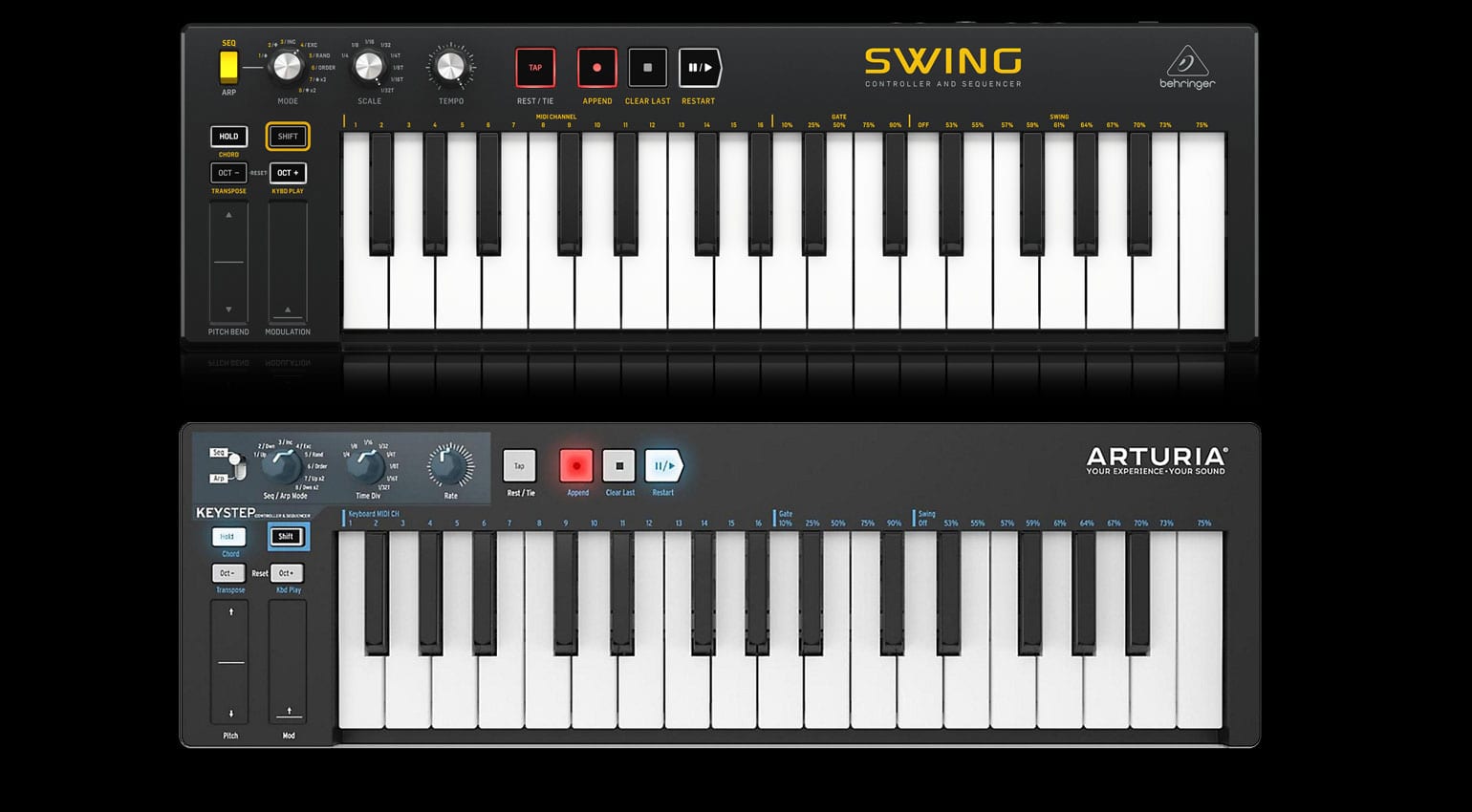
I don't think Behringer only creates clones of "out of patent" hardware but also current gear that is still being sold. I guess the latest example is the Behringer Swing that is obviously a clone of the Arturia Keystep.
There are only so many ways to arrange three knobs and transport controls on a keyboard.
This is like two mobile phone companies putting their volume buttons in the same place.
This is another weird aspect of the (often amateur, electronic) music production world - making something simple and obvious seem like a mysterious and unique breakthrough.
This is a community that likes to use the terms “aleatoric” and “euclidian” instead of “random” and “evenly distributed”. Yes, I know the origins of those two terms but I don’t care - I eyeroll every time I hear them.
> There are only so many ways to arrange three knobs and transport controls on a keyboard.
You're joking right? There are thousands of combinations of where to put things to make a clone less obvious, but obviously they didn't care to do anything of that.
> There are thousands of combinations of where to put things to make a clone less obvious
Disagree. This is like saying there are thousands of combinations of where to put doors on a car or volume controls on a phone. There are really only like one or two, and I doubt any of them are like, copyrightable.
These are simple devices with simple features, not a single one which was invented by Arturia.
If I slap an arpeggiator on a midi keyboard, do I have to put the knobs on the right hand side to not infringe on the Keystep? And at that point, can no one else put an arpeggiator in a 25-key midi keyboard because all layout combinations in that form factor are "used up?"
I just don't get the outrage over this other than I think it comes from people who already hate Behringer.
> I just don't get the outrage over this other than I think it comes from people who already hate Behringer.
Then you have your first counter-point here, because I don't have Behringer, I simply think some of their practices are shady. But no hate, and I have nothing against people who chose to buy their gear. I don't want to, because of their shady practices, but that doesn't mean I hate Behringer in total.
And no, if you have an arpeggiator on a midi keyboard, you don't have to place them in a different place than the Keystep. But if you have exactly the same features, and you put them in the same place, with a so similar design that consumer could be confused which one you have in front of you, then it starts getting into a territory that me myself, is not comfortable with.
If you remove the Arturia and and Behringer logo together with the text on the Swing, you think most people would accurately be able to separate which one is which? I think not, and that's when you're infringing on someones copyright.
>There are only so many ways to arrange three knobs and transport controls on a keyboard.
>This is like two mobile phone companies putting their volume buttons in the same place.
In this case I think Behringer directly copied the look and feel of the keystep because of its amazing success in the low budget controller space. I don't expect much innovation in the budget controller space, but this one seems to be a clear case of trademark/copyright infringement if "rounded corners" can be protected.
Whatever justifies it for you. For every extra dollar they eke out of bougie hipster, they ostracize people like me who would definitely buy one if it was $500 or $600
Companies are under no obligation to not ostracize potential customers. Do you also think that luxury car companies are shitty and ridiculous because they charge more than cars that "do the same thing"?
I do, but I am admittedly a small sample. A case can certainly be made that luxury cars, in general, are not very "good" cars in most metrics as by which the industry measures what a "good" car should be. I think OP has a valid point, if the synth Teenage is selling is inferior and more expensive but sells because "status" and signaling.
But they do sell, and Lamborghini or Porsche are not under any obligation to make a cheap car so that everyone who wants one can afford one, nor should they.
I didn't get a sense of entitlement. I see someone frustrated with features for price, then calling it out as non-sensical. I like when people do that frankly. Is it judgey? You bet, and its ok to have an opinion on the matter!
I would have agreed with you, but sourcing OLED displays is a pain in the ass. I've been personally bitten by this.
So, if they bought a 1000 obsolete displays and burned through them, it may actually take an act of God to get more. And you'll probably have to redesign your circuits.
Sure, but TE talked about the OP-1 as a 20 year project. The idea they paid the tooling costs for the body and then just slapped some remaindered displays on them stretches credulity.
I haven't heard about this. Were they busted lying about supply chain issues as an excuse to raise prices? Their stuff is pricey but cool, but if it's documented that they lied about that, that would be hard to get past.
They have talked about it some, seemed reasonable.
Also understand why it would not be a popular decision though. Think running a business, and understanding success can be very temporary if you are not careful helps.
"We have had to face other costs than the actual components’ costs of course. The currency conversion, inflation, sourcing of the new component, re-coding the display, re-designing the mounting, new tools etc. are just a few of the “why”. When Teenage Engineering faced the reality of the OP-1’s future, there were only 2 choices: kill or save. We decided to save it. I understand that the new price is a disappointment to many of our fans. But I do hope some are happy that we did not kill it."
That seems unfortunate but reasonable. I don’t begrudge anyone making that choice, and I don’t begrudge anyone thinking their prices are too high (and I don’t begrudge anyone buying their stuff anyway because they think something’s cool). I was way more concerned about the claim that they lied about it and were scamming their customers somehow, but so far there’s no evidence of that.
> The OP-1 used to cost $800, which was already a big ask for a microprocessor, OLED screen and plastic enclosure. A great machine, but a hard to swallow price to be sure. Once YouTubers started picking up on them, they chose to increase the price (blaming it on a supply shortage, since we all know how hard it is to find ARM cores and OLEDs /s), leaving the OP-1 at a bewildering $1100 total.
I gotta point out that the price increase was because the original OLED screen went out of production and they had to use a different one which required major changes to the hardware and probably software (at least that's what they say). Also the enclosure is actually a solid block of CNC machined aluminium which is quite nice and robust.
You can't determine a synth's value based on it's components, or it's sounds. A PC with completely free plugins and VST will be always be much more customisable and "powerful" than any hardware device, and have better sound, too. That's not what you're paying for.
You're paying for UX that creates the pit of success for your music-making process.
You pay for the fact that you use knobs, not mouse — although you would be able to draw an infinitely detailed automation with it. You pay for the limited choices you have, and where these limitations lead you. You pay for the touch & feel. You pay for purely subjective, aesthetic factors, like look and smell — because music-making is a completely subjective, intuitive process and your psychological state is more important for it having a Turing-complete LFO system.
I like OP-1 and I like Octatrack, but there's just no way you could have any objective "measurement" for which one is better of has better value — because any value that these devices have is subjective. If you want to decide which one to buy, forget everything about specs, and just spend an hour or two playing with them, feeling them with your hands while you make music.
I've owned an OP-1, Octatrack, and Digitone at various points.
They aren't comparable to the OP-1, which is more of a quirky, fun, expensive toy, and there's nothing else like it really. I wasn't getting anything done with it, so I sold it. But, I can definitely see how someone could have a lot of fun making songs with it.
Is it worth a thousand bucks? Nowadays you're probably better off spending half that on a Roland MC-101 or Novation Circuit Tracks.
But I always kind of wish I never got rid of my OP-1 - it was definitely the most fun I've had on a self-contained hardware device - the tape interface for recording was just awesome.
But as for the price increases, I never understood why people complain about this. They can charge whatever they want. This not a necessary item.
> Elektron is one of the few companies that pushes the envelope of digital sequencing
I think the Elektron sequencer workflow is overrated. Software is better. I understand thinking the restrictions encourage creativity (I don't personally subscribe to this idea), but the sequencer isn't "pushing the envelope" compared to what you can whip up in software.
So I guess I kind of think some of the Elektron machines are also quirky, expensive toys.
I design and build modules for the eurorack modular synthesizer system. And I can vividly remember that in the beginning, still being a student my one thought was: Why is this stuff so expensive.
Five years later, I find myself arguing the opposite in many cases. Most modular synth stuff is not too expensive, but has just the price you'd expect it to have given the number of units sold and the BOM.
Yet when I was starting out my comparison were e.g. guitar pedals, which is a much much bigger market. Electronics scale like that. Whether you sell a hundred, a thousand or ten thousand units really makes a difference in terms of pricing. And quite frankly, if you worked 2 years on development it is a bit bold to expect from you that you did this for free.
That doesn't mean there are overprized things in synth bussiness. The OP-1 definitly seems pricier than one would expect, but I don't know enough about it to say thia with confidence.
I don’t feel that an Octatrack/Digitakt/Digitone is quite a replacement for an OP-1. They may be better sequencers (I don’t have the relevant knowledge to claim whether or not they are), but I’ve always gotten the impression from professional musicians and composers that the appeal of the OP-1 is a combination of form factor and portability. It has keys in a piano layout which makes it easy to play on and it is in a small enough size that you can throw it in your backpack when traveling.
Indeed. A closer comparison would be something like the Korg Electribe, which while quite fun in it's own right, is nowhere near as capable as the OP-1. Though it is quite a bit cheaper (about $600 AUD or so)
Honestly the octatrack is just as old and overpriced. Elektron has left it behind in terms of features like “overbridge” and after learning the ins and outs of my I much prefer separate sampler, sequencer and looper.
Don’t get me wrong, the OT is an amazing box. I just think that for the money a person can make much more interesting jams on a digitakt or midel:samples and an rc505, for instance.
Comparing the Octatrack which just had it's 10 year anniversary with newer devices seems a bit unfair. I think it was a nice machine for it's time (and at second hand going rate around 500-600 euro still a good deal).
There's an advantage to not having to connect and configure multiple boxes if you just want to make some music.
Depending on your musical tastes and tolerance for UI complexity, you may be better served by other Elektron devices as your first purchase. The Octatrack is very powerful but pretty complex to wrap your head around.
Personally I’d go for the Analog Rytm mk2, especially if you like drum-based electronic music... it sounds fantastic, is a great analog drum machine but each track can also be used as a synth or sampler track, which makes it much more than just a drum machine, you can really quickly make great sounding full tracks on it. It also has a really fun interface with far fewer button combos to remember etc. than the Octatrack.
Of course, it doesn’t matter too much because once you buy one you’ll eventually end up buying them all ;) I agree that Elektron are making some of the most fun and exciting music gear out there, I love all their stuff. Quite a strong tracker influence to their sequencer which I like too!
I think the complexity of the Octatrack is a bit overstated and probably scares people more than necessary. Only confusing part is the whole track/machine/part/pattern/banks thing, but other Elektron machines have similar complexity. Or maybe it's the sequencer people are scared of? But it's a easy one with just a lot of depth.
But I'd agree with you, as a owner of both a Rytm and Octatrack, to go for the Rytm before the Octatrack as it's simply a nicer standalone machine, the Octatrack really needs companions to be fully useful.
> I agree that Elektron are making some of the most fun and exciting music gear out there, I love all their stuff
Yeah it is probably overstated, but it is definitely a slightly confusing machine compared to other modern Elektrons (I have the Machinedrum, which you can clearly see how it inspired the Octatrack).
I don't use my OT that often and whenever I pull it out it takes me a while to reorient myself with how I load a sample, why is that track muted, etc. etc. Of course out of this architecture comes great flexibility too, unmatched by anything else hardware based really, and when I listen to the patterns I've made, they do sound unlike anything I make with other gear (in a cool way). I am going to try to integrate it as a live looper for "live" performances (to an audience of one, myself, in the bedroom, but everyone has to start somewhere!).
And yeah, I'm hooked too. Got most of the boxes now, just missing Monomachine (never really grabbed me and definitely not at the second hand prices!) and Analog Heat (which I bet I'd love but it feels expensive for "just an effect"). Don't regret it all though, I love how each one is a self-contained groovebox that I can make a full track on on the sofa, but also they integrate really well for a more advanced setup. And they're just super fun!
Funny that you mention the Heat as I just got that one a few days ago as a complement to my Rytm and Octatrack. It is so much more than "just an effect" and currently sitting on my master output, making everything sound just better. Thinking of getting a second one to put between the Octatrack and my other instruments too, but have to let the GAS build up a bit first I think.
At that price I expected some actual analog hardware under that pretty case, not just an ARM chip and some OLEDs
But then again, back in the day I paid out the ass for a Virus TI, which is largely the same setup. Though for virtual analog it did sound fantastic. I miss that thing...
I like high profit margins. It makes possible (but doesn’t guarantee) better design, better working conditions, smaller volumes, healthy second hand market etc. I love OP-1 but in the end it’s going to be waste. We are in huge trouble optimizing for ever cheaper everything on this planet. If we would be talking about healthcare, food, housing, education I would be more on consumers side, but teenage engineering makes toys for people who have maslows lower levels covered.
People have been making the same argument about Apple for years. Execution matters. I'll pay a premium for a product that works and has a high quality product design.
Obviously TE is a company for profit. I don't feel it's a bad thing for them to do so. This proves there is a market for such product, and the competitors should see the opportunities and try to make some great design products that would catch everyone's eye. As a result, it should benefit the consumers.
Sure, you have to wait for a while if you don't want to throw cash to TE, but such cool-kids-toys are not expected to be cheap anyway.
You don't understand their pricing because you don't understand what they are actually selling. They don't sell musical devices, they sell status symbols.
You buy an OP-1 to look cool, not to actually make music with it. It's a bit like with the iPhone, but on a whole different level.
Some buy fancy sneakers, others buy fancy pens and Moleskine, others buy an OP-1.
And you can't have a cheap status symbol.
This is also why they look so clean and minimalistic, like a MacBook, to the point of sacrificing ergonomy, since the aesthetic is what they are selling, so they can't look gnarly, black and full of ports and cables like an actual musical device.
This is simply not true. I own a lot of synths, and the OP-1 is a very capable (and extremely portable) 4 track studio. I sketch a lot of music on it, and it sees regular use in the studio.
There will always be a collector class with any category of designer product. Established manufacturers (Nike, Monte Blanc, Omega) are aware of this and directly cater to those customers. I don't think this was TE's intent when they launched their synthesizer.
The OP-1 is an incredibly well designed product that stands on its own as an instrument. The device has taken on the life of a status symbol somewhat in 10 years, but is that due to TE or due to the quality of the product? Synthesizers have their own collector class after all, but I don't think you can accuse TE of intentionally catering to those folks when they made the OP-1. People like good design for many reasons. The OP-1 has an undeniable aesthetic quality but it's a versatile and flexible (and portable) instrument under all that.
That's a very bad hole to dig with "most people buy it because" nonsense. Why do YOU care what others buy or don't buy? Were you ever going to get one? Even at $400-$600? It smacks of "I don't want this, therefore NO one should want this...and if they do they are only getting it because blah blah blah".
Let people like/use/play what they want and stop judging others for their choices just because they're not YOUR choices. I, btw, don't own anything by Teenage Engineering, but it absolutely doesn't affect my world one iota if someone else does.
Do me a favor and go on YouTube or Instagram or Facebook and look up the million videos of people making music with it. You don’t know what you’re talking about here. I don’t know a single person who flashes their OP-1. By your argument, owning a guitar and only knowing a couple chords is “status symbol” purchase.
You know what I see in 20% of instagram pictures tagged OP-1? Cassettes. Are you telling me there is no hipster aesthetic that a lot of these posters aspire too?
If you don’t like some particular piece of music, just say so, but you’re pigeonholing a lot of people, and it makes you look like you’re saying “they’re wearing bellbottoms! This isn’t art!”
The first time I saw an OP-1 was the MoMa design store. It took me a few minutes to realize that expensive synthesizers are the new unplayed, high-end electric guitars that boomers like to buy.
Modulars and multifunctional devices like the OP-1 or Octatrack seem to be what "the kids" are interested in, if they buy new hardware - there is just more "bang for the buck" when you go with those options. Vintage synths are fun curiosities, but with prices skyrocketing, most everyone turns to the very accurate software reproductions to actually use the sounds.
It's a very rapid divergence between collectors and users.
There are plenty of musicians using classic hardware, not just collectors. Same with guitars.
OP-1 and Octatrack provide a different workflow but the classic stuff provides a truly special sound. While the software reproductions of vintage analog synths get you 90% of the way there, musicians want 100% of the sound. If that weren’t the case then you would see prices of classic instruments go down.
I am not a pro musician however, I just want to noodle every so often for fun.
In my experience the collectors and 'gear junkie' crowd are the people buying the vintage stuff now (and obsessing which of the dozens of 303 clones sounds most like the original) while the pro's just make music with whatever equipment they have and like...
I didn't say they have to be, just that the vast majority are, maybe because they get a lot of usage and black is a good color for hiding dirt, maybe because they stand out less.
> "they look so clean...sacrificing ergonomy, since the aesthetic is what they are selling, so they can't look gnarly, black...like an actual musical device."
You're arguing that because they are a status symbol and have to look "clean and minimalist" they can't look black like an actual music device looks like. Of which I think your main point in that statement is that OP-1 != "actual music device".


If you, the reader, has $1100, pick up an Octatrack. Elektron is one of the few companies that pushes the envelope of digital sequencing and hardware production, and the Octatrack is the pinnacle of their work. At $900-1000, you'll definitely get more mileage out of it than an OP-1, and you don't have to support Teenage Engineering's shitty pricing schema. Even at $600, you can buy an Elektron Digitakt/Digitone, which will probably serve you better in the long run.