I am feeling the chill in the circle of companies I know.
Other thing that should be mentioned: a lot of initiatives at a lot of companies over the last two years just didn't work.
Feels a bit like we are at the tail end of a pretty big macro cycle of tech companies green lighting big initiatives with optimistic mindset and now a few years later the due bill is coming and the bets just didn't pay off.
Maybe a big example would be Twitter: a few years ago they were straight up hoarding engineers; fast forward to now, what did all this amazing engineering talent get them? Maybe nice code but the engineering they've done hasn't been able to increase users.
The reason engineers get paid well is because of their extreme leverage: just a few engineers can pull off amazing results. But you eventually need the results. And if the results are not there, broadly, then there will be a reentrenchmet.
My leading indicator is that my employer (big, slow, enterprise) is hiring like crazy after a few years of low hiring of new headcount.
We're actually hiring good people in entry positions, which is an indicator that smart people are looking for stability, good benefits and mediocre compensation. That usually happens ahead of poor macroeconomic conditions for a variety of reasons.
I generally agree that the brightest and most enthusiastic engineers I've ever met hated big enterprise tech teams, but it doesn't mean that someone isn't good at their craft because they've spent a long time in enterprise.
In general the popular reasons for disliking enterprise tech:
- The tech is generally years behind what people are doing now and risk aversion is generally above all else. No new and shiny, which means you're generally not that attractive to other companies that are doing pretty cool stuff.
- Everything is slow. Things require approval from people who have no idea who you are and what you're trying to accomplish.
- Apathy. You are but a tiny cog in a very large machine. Your Herculean efforts may not even cause a ripple anywhere outside of your team (if that) so why? Punch the clock, do your job, go home.
- Beauracracy. See risk aversion and apathy. Your novel idea is but a flight of fancy that could cause a middle manager with no technical expertise a bonus.
I spent my first four years out of university working for very large companies and I was so very bored and stifled I was crawling out of my skin during the work day. I also found that I could get a month's worth of work done and be so far ahead of my peers in a week that I could basically check out, show up just for meetings, then go to a coffee shop/"work from home" and work on my own projects or consult for other companies.
I definitely learned things about process and organization that could be scaled to smaller teams and companies that continues to help me today, but I could never go work for a huge company again.
Just playing devils advocate here, but what I just read was "I got awesome stability and a good paycheck, and while that part of my career wasn't all that interesting I had plenty of time to do other interesting stuff with almost zero risk."
In some other HN comments over the years I've suggested that a very good path for young people is to start with the big companies. You will likely be set up with more support, free time, and lower stress so that you can get your feet under you and figure out life in tech with little risk.
For the enthusiastic and generally well prepared you will likely be bored in 6-9 months. Maybe a year. For the very green, "I got into CS because of the paycheck/whatever" crowd, they've probably found their career.
The big companies treated me as well as they could in my short stints and I was paid VERY WELL coming out of school and I learned a ton about careers in technology and how it's not just about the code and I truly feel I owe my career jump start to my experiences at those first three companies.
However, I'd never go back to working for a large company again. The variety, multidisciplinary teams and tasks, the ability to affect change in a smaller organization, the camaraderie and enthusiasm displayed in even a 100 person, 15 year old company aren't even in the same ballpark as those of a big company.
I had a similar experience starting out, and when I moved to startups I felt that way for a long time, but I took on an enterprise client I've been working with for about 2.5 years now and its kind of awesome. Not really a typical situation though—flexible hours, small group that runs really well, we get to do basically whatever we feel like the situation calls for. I could definitely see it going the other way if they were more like an HP or Dell or <insert F500 company here>.
Simply put: Better to be getting low pay at a stable job where you can wait-out an economic down-turn, than be unemployed because all the cool employers that you'd rather be working for have had layoffs and aren't hiring.
Budget is driven by business and income tax (i.e. profits and bonus) both tend to peak before things go south. This .gov uses archaic cash accounting, so they always focus on current cash flow. So if we have cash to burn, that means things were great last year. :)
Businesses in particular always invest in growth, so lots of revenue means that growth prospects are tightening, even though things look great in the present.
People who are good at what they do, do not need, nor want to work for a big, slow enterprise. Many of the people hired into entry positions will soon move on. The ones who stay, are usually the ones that you actually did not want to stay. Therefore, at some point there will be no other solution than to orchestrate mass layoffs again. Watch out, because the fact that you have been working there for a long period of time will be used as a counter-indication for talent and ability. It is exactly the ones who have been there 10+ years that are high up the list of people who will be laid off.
It's a different mindset and pace, that's for sure. But I disagree with the implication that enterprise devs are not talented.
Of course not all of them are, but I've worked with very talented devs in traditional business IT shops. They worked regular hours, had families and lives outside of the office, they didn't necessarily know (or chase) the hot tech trends but they knew what they knew inside and out. They didn't have to use Google or StackOverflow to write code. They had been around for years, knew the business and the systems and could take a fairly vague requirement and deliver exactly what the user needed without a lot of discussion.
They weren't blazing trails or disrupting anything, just doing solid work predictably and well.
> Feels a bit like we are at the tail end of a pretty big macro cycle of tech companies green lighting big initiatives with optimistic mindset and now a few years later the due bill is coming and the bets just didn't pay off.
Exactly my perceptions as well. It seems like VCs and the tech scene in general put growth over profit in a big way for the last 3 - 5 years. That's a fine way to be for a lot of businesses, but my feeling is that companies and the hivemind got a little to comfortable with it, and rather than delaying profits for growth in the short term as an explicit strategy, began to take it for granted as an acceptable way to operate a business in the early days.
The days when "Ramen profitable" mantras abounded and everybody praised 37signals have definitely quieted down, including on HN.
And now it's been long enough that the tide's going out and we're seeing who's still got trunks on.
I don't think the whole thing is going to crash into the ground, but I think "peak easy money" occurred in the past 24 months and has passed. I expect companies to have to work harder to prove they're actually bringing in cash.
IMO, this is just as it should be and the market is correcting for valid reasons.
----
Semi-related anecdote: SF's insane rent prices have mostly plateaued in the last 9 months, especially compared to past growth, and I hear the occasional whisper of them falling. Most news orgs get SF rent prices way wrong (by extrapolating bedroom prices from home purchases, not rentals, for example), but as someone who's lived in the city for a few years and changed apartments annually, I've got a decent calibration for the market. This is a trailing indicator, and to me signals that tech workers are less financially risk tolerant, and perceptions of "my financial situation is stable or poised to improve" are on the decline. Nearly all of my friends express worry over finances, despite making north of 100k.
Very true. The number of companies that can hoard talent without high leverage projects is small. I can only think of Google. And even there, they are retrenching in some of their moonshots.
I really don't mean to be rude or disrespectful, but how it "feels" isn't really interesting or relevant to the question of "is tech hiring actually down". The OP presented data to support its claims. The data was (imo) very flawed, but at least it provided something to start a substantial quantitative conversation. I think the OP's argument should be praised for "failing fast." By contrast, the internet of hunches is more or less immune to scrutiny.
I don't know which way the prevailing winds are blowing in tech. I could swap anecdotes with you (a tech investor I had a beer with recently seemed very happy? my giant tech employer and its competitors are doing great!), but I don't think it wouldn't get us any closer to the ground truth.
There is nothing wrong with people sharing anecdotes, experiences, feelings, impressions, idle thoughts, and speculations in HN threads. On the contrary: HN threads are conversations, and those things are the life blood of good conversation.
True, the article title made a factual claim about data, but that doesn't mean commenters aren't welcome to share their related experiences, or deserve to be chided for not presenting rigorous evidence or treated as if they don't know the difference between the two (which does seem a little disrespectful, though I appreciate that you were trying not to be).
Data, even if only qualitative, about the psychological experience of technology workers seeking employment is very interesting to me. It may have fewer direct applications to policy adjustments, but provides insight into the overall mood and sentiment around tech hiring and employment.
The psychological and sociological aspects of tech employment are not discussed as much as they should be and it is a disservice. Again, I love data-driven policy as much as the next Bayesian, but positive description is not the only thing that has value. Sometimes normative description also has value, even if it emerges from a sparse set of qualitative descriptions.
I personally would like to see much more anecdotal data about how people feel about tech employment, because I think at this moment in history the interface between organizations and employees represents one of the most significant moral problems on the planet, that has wide-ranging effects stretching from income inequality to PTSD or depression to stagnation of innovations that could alleviate poverty or diseases, etc. In the same way that some claim that governmental regulations stymie tech progress, I feel it's perfectly analogous and perhaps even more critical to point out that organizational bureaucracy in the form of anti-human treatment of workers, candidates, and the unemployed, is just as much of an impediment to collective progress, but is much less talked about because it's fashionable to hate on government but taboo to hate on ethical failures of companies in their treatment of workers, candidates, or the unemployed.
I don't disagree with you that "how it feels" is an important aspect of our lives. It is not, however, an important aspect of answering the question "is tech hiring down 40%".
If someone says "pneumonia diagnoses are down 40%" and someone replies "I disagree, it doesn't feel like doctors are diagnosing less pneumonia to me," nothing of substance has been added to the conversation.
That said, I also think that I interpreted the purpose for posting the article too narrowly.
Edit: to be clear, I don't intend to diminish the concerns you listed. The argument "A is irrelevant to B" is not the same as "not A" or "A is irrelevant"
I agree with you. I think I am saying that I don't mind if discussions about "is tech hiring down 40%" also include discussions about "tech hiring sure feels like it's down because here's my experience ...".
They are "relevant" in the sense that it provides a logical repository for information about how the job market feels, both factually and emotionally. I don't see much benefit in asserting such a need to keep the topics separate that even a comment thread on Hacker News cannot mix the two kinds of assessments together.
One thing that piqued my interest is that he said they've been tracking their competitors' job ads "for a few years." I would have liked to see his competitors' numbers from '15 or '14.
Disclaimer - This is all gut feeling and anecdotal evidence so feel free to ignore.
I suspect that jobs being posted to smaller niche job boards (such as Authentic Jobs, which I hadn't heard of until this post) is down overall, but this doesn't reflect the state of job availability.
I believe larger job sites are having enough of a network effect that these boards are becoming less relevant. Most tech job seekers I talk to are going one of four routes.
1) LinkedIn (Facebook for job seekers)
2) Indeed (since it aggregates)
3) Direct application (when you know a specific company you want to work for)
4) Recruiters (Let them do the work for you...)
On the anecdotal front (within the past year) I have been contacted twice by recruiters that took me out and bought me lunch to try and woo me to another job and once contacted directly by the CEO of a company who did the same thing. I want to make this point clear; I'm no one special just a regular software dev with 15+ years working experience.
During one of these lunches the recruiter said to me, "It is so difficult to hire qualified developers that I would say there is a NEGATIVE unemployment rate currently."
I have spoke with multiple company owners, CEOs, and others who are in the hiring position and the general consensus is they can't find qualified help.
I can tell you from my own experience that the "negative unemployment rate" comment is false. I have been unemployed since March, and I've had no less than 12 in-person interviews, some out of state, and countless other contacts all resulting in rejections.
These were positions I am qualified for, and that I know I would have succeeded at. I've been told it would take me 6 months to start contributing to a Python codebase even though I have significant experience in the language and the problem domain for that project. I've been told I have too little experience mentoring a team despite doing just that at my last job. I've been told I don't have enough JS experience for a position that did not ask for any JS experience.
The market right now is poor for a developer without a fancy CS degree, or one without the luck of a golden pedigree from a previous high profile company.
I'm trying to tread carefully to avoid insulting you. You are very likely more talented than I am, so please take my input as just one data point.
An outsider perspective: 12 in-person interviews is a high amount of interviews without receiving an offer. I've failed my fair share of interviews but never that many in such a short amount of time.
If I were in your position I would try to get as much information as possible why you weren't accepted. Anecdotally, Austin should be a promising location for tech hiring. It may be a personality clash or a lack of preparation. I have bombed several interviews because I didn't take the time to practice Google-style interview questions. It took me 2 months of practice before I was ready to interview successfully in SF, coming from the East Coast.
Fancy CS degrees and golden pedigrees get your foot in the door. The technical interview is up to the applicant to pass or fail. It looks like you get your foot in the door pretty well. Now it's time to focus on what you can do to convince these businesses that you will help make them money.
No offense taken. I fully admit to underperforming on some of the whiteboard sessions I was subjected to. I also don't think I performed so poorly on all of them to get nothing but rejections. I am not a rockstar, but I am competent at what I do - but what I do is not whiteboard code toy problems.
I always ask for reasons for the rejections, but I rarely get a response. Some will give insight (as I stated in my original comment) but the vast majority will not tell you any reason.
I am just offering a piece of data to refute the "negative unemployment" claim and its ilk.
I appreciate your contribution to the discussion. Different opinions make HN special. I empathize with your situation; getting hired while unemployed is much more difficult than under better circumstances.
Perhaps you happen to suck at interviews, or at least parts of interviews like whiteboarding. For me, there's a reason why I don't go to Trivia Night at the Programming Saloon despite interviewers enjoying playing Trivial Pursuit during an interview.
"Practice Interviews" are a thing. Have you considered trying such out?
This is likely. I am deficient at whiteboard "coding" to solve toy CS problems, which is de rigeur for developer interviews right now. I think I've gotten better with practice over the past months but this doesn't seem to bear results. I have gotten to actual, workable solutions on the whiteboard numerous times and still nothing.
I haven't done a practice interview, but another poster offered to help me with that. I may take them up on their offer.
I wonder if there is something in your personality that turns people off? Are you overly aggressive? Do you seem unfriendly? Honestly, it sounds like you just might need to sharpen your people skills a little bit! Those are important too :)
I can't figure out what, from the parent's comments, would make you draw this conclusion that it is a people skill problem when it sounds like a classic "whiteboard interviews are a total crap shoot" problem.
This experience is not even at odds with the original quote from the recruiter - when the recruiter says "qualified", all they mean is "able to succeed in the hiring process companies are using". Unfortunately, that definition of "qualified" often doesn't have much in common with the usual definition of "capable of doing good work". The parent commenter may well be qualified in the second way but not in the first.
I hope there isn't something I'm doing that indicates I'm not good to work with, but I haven't ever gotten any feedback like that. I try very hard to be even-handed and pragmatic about how I speak and treat others, and I'm always willing to help or chat about... anything really.
I always ask for reasons for the rejections, but I rarely get a response
It's unlikely you'll get a response like that after a 'no hire' from legit companies. They avoid giving that kind of feedback because of legal ramifications.
My situation was possibly relevant, although atypical. I moved back to SF after decamping to NY after the dot.com crash. I started a company there which failed after five years, and then consulted for around three. Landed back in SF and had a terrible time finding employment in a very tight job market. The strikes against me were consulting, starting my own company and having a skill set that did not include several trendy buzzwords that were not in demand with the folks I had been working with. And, possibly, being honest about that[1]. A fuzzier but no less real problem was that the network of folks I knew in the Bay Area shrank a lot, and that's how I've gotten most of the work I've ever had.
I did finally get a position. It sucked in a lot of ways, and my commute really sucked. But after a year, I was coming from a recognizable, local name and that appeared to make all the difference. So now that I actually like my job, I filter head-hunter mail to a separate mailbox and write pro-forma 'no thanks' in batches.
[1] I am mostly honest in my work history. I suppose I lie by omission - I don't want to ever write Java again, so I've purged references to it from my resume. But it seems that a lot of folks find creative definitions for words like 'experience'. I know some whom I didn't hire did, and people I know are not terribly embarrassed by admitting it. It would be interesting to see some anonymous survey stats on the question.
Getting reasons for why you're not getting hired from companies is basically not an option- even if they tell you anything it's likely safety speak BS unrelated to why.
As a guy who's been on both sides of the metaphorical table I know what it's like to bomb but it's almost worse when you feel like you did well and then really have no clue, so I empathize with you for that.
From the other side, I implement an everybody says yes hiring scheme. If an interviewer says no we talk about why. We've had most technical no's overturned when the other interviewers relate a positive interaction in a similar technical area and we come to a conclusion that it was as simple as how the question was asked, or maybe that is a specific weakness made up for in another area.
The no's that are almost never overturned are the ones where an interviewer just didn't seem to like the candidate personally. I don't expect everyone to be friends, bristly people are fine if they're generally capable of some team play, but if someone walks out of that room saying I couldn't stand to spend more time with that person than my family, that's it- we're not going to hire.
I don't want everyone on the team drinking from the same kool aid, and we don't have to be friends or even that friendly. We have to be able to work together and get shit done, and if one of my employees I trust enough to do interviews says no, then even a very talented developer isn't going to join the team.
With all that being said, I don't know what kinds of teams you're interviewing for, it may be a niche thing or it could be they don't like you- it's a relationship though, you will eventually find a decent match.
If you want to do a trial run through with me with a no bullshit no PC response as to my opinion on it I'd be happy to carve out some time. Message me on Twitter @ashurexm and we can set something up. You've got to have pretty good skills to get 12 in person interviews in a shortish amount of time.
@jakebasile, Whether you take manyxcxi up on this or not; I think s/he is making a great suggestion here. 12 interviews and zero offers is a lot of interviews. A few feedback style interviews with some candid feedback might do you some good. Technical skills aside it is possible you just are not interviewing well.
Also a couple of somewhat related questions.
1) How well are you at reading the interview outcome? Do you leave these interviews thinking you will be made an offer or do you leave with a pretty good idea that a no is coming your way?
2) Rather than waiting for a rejection and then asking "why not", have you tried asking for the "why not" during the actual interview? At the end of almost every interview someone will wrap it up saying something along the lines, "Do you have any more questions?" I have had plenty of candidates ask me (and I myself ask if I'm the candidate), "What do you think I could have done differently today to improve my chance of success with your organization?"
This is usually met with a more honest feedback than the ask after rejection for numerous reasons.
1) Less HR cover my ass BS; after the rejection companies are worried anything they say could be used to sue them.
2) More people in the room so you may get more than one perspective.
3) You haven't yet been rejected so you may also hear some positives; "Well you really impressed us on X, but you could focus more on Y." This can help you to play to your strengths in the future as well as areas you need to work on.
Yes, I've replied to them separately. I think it would be valuable as well.
I gave up on trying to gauge the outcome of the interviews. Most of them I thought I did very well on, some above average, and a few I knew went poorly. All of them had the same outcome.
One interview battery in particular stands out. I interviewed at least 6 times over two weeks, some 1:1, some 1:many. I interviewed with the team, an unrelated employee for a culture interview, the VP of engineering, and a C level exec. All felt great, all feedback from the recruiter was positive, but after everything was done I was told the position "wouldn't challenge me enough" or something similar. I was devastated.
I have never thought about asking for interview feedback during the interview. That is a good idea.
Thanks for the thoughtful reply and generous offer of help. The responses I have received indicate (if they mention anything at all) that the team liked me, thought I was a professional and friendly person, good at conflict resolution, and so on. As you say, it might just be a smokescreen but I have no conflicting information from anyone I know or previously worked with telling me that I'm not a good teammate.
I'll send you a message soon, it would be helpful to get an outside opinion.
All one can do is go by what they say. There is a third option that I've been on both sides of as well: they think you're too expensive and/or you'll be a flight risk.
I've had a number of occasions where the feedback was overwhelmingly positive and I just knew I was having a great run only to not get an offer and an explanation via the recruiter (mine or theirs) that they just couldn't afford me. This is a totally valid reason, but I usually make it clear that $X or the general vicinity plus other considerations is the starting point and give them an opportunity to bag out early- so this is an outcome that pisses me off with the caveat that I've had the budget reduced for a position mid-hiring process so I know it's not necessarily BS or intentional time wasting. The one time it happened to me I let them know for real what the reason was and they wound up working for us a year later.
Whenever I say someone's too expensive internally it has meant that they don't come armed with the tools I'd expect an $Y per year salary would warrant. Sometimes they're our best candidate and we just "pay and pray", other times my feedback is just that, "We don't value what you bring to the table at the same level you do," and we try to negotiate.
The flight risk is the trickier one, rarely will people even hint at this. They're either worried that you're going to be bored quickly (which comes up a lot depending on the role) or that you seem to be chasing money and/or titles.
If it's the former I specifically tell them we like them, we want to make an offer, but we're worried that the day to day work may be unfulfilling in the long run based on what they've made us think about them during the interviews.
By the way, my anecdotal track record for this is pretty good- these people are usually gone in 18 months, which is just about the time you hit your stride and go on auto-pilot plus a few months to figure out you're really effing bored. I can't recall anyone we've thought this about that stuck around past 30 months.
The job hopping and money chasing is what it is. If it's true or not, you can't really unbrand yourself of it when they perceive it. I don't begrudge anyone for doing it, I have never been at the same company (whether for myself or others) for more than 4 years. I think everyone should be looking out for the best interest of their careers and families, your tenure at a company doesn't guarantee a thing, just do your best and be ethical while you're there. Be that as it may, if I've got two generally equivalent candidates and one is perceived to be more likely to stick around, s/he'll get the first offer.
I have made a point to indicate I am very negotiable with compensation to help my chances, but that doesn't seem to ever come up. The recruiter asks a number, I give a guess based on my experience and my last salary, and it never comes up again. No one seems to take up my offer to negotiate.
As to job hopping, I have worked at 3 companies my entire career, each about 2.5 years. I had good reasons to move each time, and I didn't do so lightly or recklessly, but there's nothing I can do to change that. With my experience job hunting, I'd be very happy working at the same place for a long time.
"but it's almost worse when you feel like you did well and then really have no clue" true, true Had that experience at a certain CIA backed entity in the west village. Really wished I could have gotten a post mortem.
Sometimes it is purely economic - I had an offer withdrawn back in 2009 and later had it reoffered when the company was in better times.
It sucks to have something go sour when the interview process has positive momentum
Along the lines of your "offer withdrawn"; in 2004 I had an offer from Acclaim. We agreed on a number and HR said they would be sending me over the official offer letter and start date by the end of the week.
The week comes and goes, but no contact. The following Monday I give a call and leave a brief follow up voicemail, "Hey, haven't received the offer letter, just checking in." (something along those lines). Finally about three weeks later I get a call from this poor HR woman; she tells me that Acclaim has declared bankruptcy and she is really sorry she didn't contact me earlier, but that she had shown up to work one day and the doors to the office were literally padlocked shut and under guard since their assets had been seized for auction.
How often does that happen? I feel most people kinda like or are neutral on most other people. I can't remember the last time I met a developer I thought I couldn't work with because of his personality
I've only ever come out of an interview one time thinking that the guy I was talking to was a real jerk and I'd never work with him. I've come out of most pretty meh, just as you said.
For a stretch we probably did 70 interviews a year for 3-4 years spread across 9-15 participants. It seems like every year there was at least one HELL NO candidate on personality by someone.
There's also a bias against the currently unemployed. It took 6 months of hard work for a friend of mine to find a job after he quit one after 3 months without anything lined up, because it was such a bad fit that it was making him depressed. Up to that point, he had zero problems finding a job, the only difference was his employment status while job hunting.
Yes, I think that has contributed to it as well. In retrospect I should have started lining up interviews when I saw the company might fold, but I had never had any issue finding employment in the past so I didn't prioritize it over trying to right the ship.
2 years ago I moved to SF from a shithole city. I had taken off like 3 years to work on my own projects. It was more difficult than I expected to find a job without any connections. Took about 3 months after moving here.
I think there's at least some bias against people who have taken time off because they appear comfortable not having a job and therefore the company has less leverage over them.
I think the bigger bias at play is the just-world fallacy. Employers assume that everyone who is unemployed must be unemployed justly because something is wrong with them (e.g. they're incompetent, slackers, toxic, etc.). That's the problem my friend had: the company that eventually hired him admitted they spent a long time trying to figure out what was wrong with him, even though they liked him.
I think a lot of it is the new "100x developer" mentality.
Companies have become insanely picky. I've had lots of interviews, many of which went really well that never panned out. I've completed significant projects for companies, and I have some open source software out there too.
Companies have become convinced that 99% of developers are as valuable as a pile of dog shit they just stepped in, and its changing things. If you're bad at marketing, you're in for rough times ahead.
Hang in there! It took me closer to 25+ in persons during my last search. Of course once you get the social proof ignore offer everyone else gets in line. :-)
I do, but it is relatively small. I've worked at smaller companies or smaller teams since I've been in Austin. A few of the interviews I mentioned were through people I know and who personally vouched for my capabilities. It didn't change the outcome, unfortunately.
"It would take me 6 months to start contributing to a Python codebase even though I have significant experience in the language" - Python, specifically, suffers from its own "ease of use" when it comes to hiring and "years of experience" listed on resumés. A hacker who happens to use Python to automate some tedious task but has no clue about how to actually write idiomatic, well tested and maintainable code can claim "4 years of Python experience", for example. To sum, it's very easy to write and maintain truly shitty Python, and "years of experience" mean especially little.
I agree, which is why I always make a point to go into specifics about what I did in Python, what the product does, and that it is still used at the company I created it for.
This might be part of your struggle, perhaps, as those kinds of things ("product did x y and z, I wrote it by myself, it's still in use", etc.) fall into the "solved a problem" category (valuable, don't get me wrong) rather than the "built a clean, maintainable system" category ("100% test coverage, followed sem ver and git flow, maintained a 7+ on pylint, used these design patterns", etc.).
Folks in the latter category don't need 6 months for any Python-based system. Folks in the former category are useful in certain ways, but difficult to plug into a larger team, and if companies know enough to know they need a "Python" developer, that's because someone technical already picked Python, and the position is to work with at least that one other technical person.
It's likely similar with JS, Ruby, and other "newer" languages that have reputations for being "easy to pick up".
Consider Supply and Demand. The probability of being hired depends on available supply of applicants.
Graduated from UC Berkeley, Regents Scholar, Computer Science. Depths of the 1989-93 recession, I graduated in 1991. Had 4 job offers! All 4 were scut work jobs. But I got my foot in the door when the rest of the economy was AWFUL. "Dang, I was the top of my class in CompSci (software) at Berkeley, yet I cannot get a better coding job offer than these 4?"
LATER I REALIZED: The recession started in 1988-89. By 1991 when I graduated there were a lot of HIGHLY EXPERIENCED and TALENTED software engineers looking for work. The Supply of engineers was high; and demand was low.
So yeah, I got 4 scut job offers because firms had their pick of great, experienced talent. The fact is, I was lucky in 1991 to have gotten 4 offers at that time; George Bush the 1st lost the election in '92 because of the bad economy.
The 1989-93 recession was BAAAD. Not as bad as 2008-09 but lots of homes in foreclosure, hiring was zero.
When 1993 rolled around, the supply of talent had been TAKEN, the tech economy was hiring. It became MUCH easier to switch to an area of software completely unrelated to my old job.
But then 1999 rolled around -- the big crash, the Dot-Com Bubble Burst. Now, despite 8 years of experience, again the supply of engineers was very high and it became difficult to get a position.
If the Supply of Talent looking for work is High -- 12 in-person interviews and no job is MUCH more likely than in boom times.
Take off the blinders people. If it feels like it suddenly has become more of an effort to get a job, MAYBE the supply of talent on the market has increased.
When I hire and the talent pool has swelled, I can sit back and be picky. I have the leverage. I am the Demand for talent. You are the Supply of talent.
If it seems harder/longer to get hired all of a sudden despite what you've described -- "highly relevant experience" and a few years in the industry --
it's quite possible that you're competing with MORE ENGINEERS for that position just now.
And as I hiring manager, I know dam well the resume quality has jumped and there are more quality resumes than I've seen in the recent past.
"Ah-HA! I finally have some leverage over the applicant pool! I'm gonna be picky!"
The market right now is poor for a developer without a fancy CS degree, or one without the luck of a golden pedigree from a previous high profile company.
Or "pedigree" in the form of recent experience of certain high-value technologies or frameworks (as if most of these weren't trivially learnable).
I also have the sense that there's a "J-curve" of sorts with regard to demand: certain categories of developers are deemed "hot" and are in very high demand, for certain reasons; for others, it might as well be the mid-2000s, for you -- especially if your skillset reads like it would have been "hot" in that era.
And as usual, should you have the misfortunate to be unemployed for whatever reason, for any lengthy of time -- you're fucked, of course.
Right now we have about a half dozen open developer positions that we are so far unable to fill. The problem is the vicious intersection of relatively dull work and relatively low pay. We've had to increasingly go the route of hiring contractors since we can pay them basically anything, whereas actual employee pay is set by the legislature who don't win points with voters when they spend more on state employee salaries...
So, if there was a legitimate tech job shortage, it would be trickling down to more applicants coming to us (which has happened in the past). Right now, I'm not seeing it.
Yes, an employee of Washington State. The state government is divided into agencies, who can approach hiring differently (some almost exclusively use contractors, other try to use exclusively employees). Contractor pay is negotiated by each agency with the contracting firm; but employee pay is set all the way from the top (the state legislature).
So, for example, if I say "I can't hire anyone that meets your 'expert' qualifications for $65K/year", there's nothing my supervisor, or his supervisor, or the CIO, or the agency director, or even the governor can do; other than recommend we switch to using contractors which has its own downsides.
There's been an increasing push that has been heard for IT salaries to be "re-evaluated", but it's suffering from politics and all the usual high-level government malaise. It'll be at least 2-3 more years before anything happens, and there's a 50/50 chance that the outcome is "we should pay you more, but we won't."
That's the same excuse they've used for not giving "cost of living" increases most years. :)
Given that you can hire all the contractors you like... couldn't you just set up an external NGO consulting agency, which you contract work out to, and which has a "deal" to provide their employees insurance/benefits/pensions through you equivalent to what you'd provide—and then making your "hiring" process into a "certification" process that gives people exactly the credential said NGO cares about?
In other words, why not do what the military does, and branch off a civilian subcontractor?
When I mentioned the problem to one of the state HR folks working on the compensation thing for IT, she said, "Ask not what your state can do for you, but what you can do for your state." Which is a fine sentiment, but doesn't help me actually fill positions with people who won't be a net negative to the team.
Have you thought about hiring people for those positions as full time but actually only working them part time? You could probably find good people who don't want to work normal full time jobs but would like the benefits that usually only come with full time employment.
> Have you thought about hiring people for those positions as full time but actually only working them part time?
In state agencies, that's a pretty good way to get yourself and the people involved fired (and possibly worse), since its essentially a conspiracy to defraud the government.
In some/many government agencies, this is the nudge-nudge-wink-wink way things are done. Explicitly planning to do this, however, would probably not end pleasantly for the parties involved.
Some agencies more than others. I've recommended we move to hiring "in-training" positions to enable us to pick up sharp junior devs andd give them rapid advancement (within the very limiting structure we have, of course).
Some agencies hire exclusively junior devs and leave all the higher level architecture, etc, to contractors.
Our agency tries to hire almost exclusively senior devs, and has a real hard time of it. Getting junior devs is easier.
If you're interesting, go to careers.wa.gov and do some searchers. It will show all agencies and you can see salaries and requirements. Entry level developer position is generally ITS 3; ignore the "2 years experience" or whatever. We routinely hire ITS 3 positions with no formal experience, just with either some schoolwork or "learned on my own" programming, or both.
Or create your own junior devs and turn them into mid-levels in a couple years. Take a look at the University of Texas's Software Developer Training Program[1]. They have similar problems with respect to hiring, with the additional problem that there is a lot of legacy code in proprietary technologies to maintain. So as a solution they began hiring for aptitude, not knowledge, and putting their trainees through this ~6-month program. The net result is specially tailored devs who know their systems pretty well. They have a strong community of developers who all have a certain background in common. There's a tacit understanding that trainees will stay on long enough to make the University's investment "worth it," but I don't think that's much of a problem. I think most trainees are "grateful," so even though they don't necessarily make what they would in the private sector, they stick around.
I went through this program and ended up working there for three years. Have recommended others go through it as well when they began pursuing careers in tech. Can't speak of it highly enough.
I don't think I buy the premise. "Tech job listings on one website are down 40%" seems more accurate, and is much less scary. It definitely helps that the author mentions that they track their listings compared to their competitors, but I'm baffled as to why there isn't a graph that covers more than a six-month span when the thesis spans years. If this company has job listing data for multiple listing websites that goes back to at least 2014, that'd be interesting data to look at, but it's not here.
Even then, I'm not sure "tech hiring is down 40%" would be a reasonable conclusion to draw -- it's like saying, "the newspaper only had 15 job listings in it, the American economy must be in the toilet."
First, the job board can only tracking "listings", not jobs or hiring.
- Perhaps job boards are slowly dying as a way to fill jobs
- Perhaps you're not tracking the job boards that are growing the fastest and only the same "nearest" competitors
- Perhaps job listings used to exist for jobs that weren't ever hired for, and now listings are more accurate
- Perhaps listings used to live for a long time, and now they are filled faster reducing the backlog
- Perhaps tech jobs are shifting away from smaller companies that would use a job board and back towards bigger companies that use other methods to hire
> - Perhaps job boards are slowly dying as a way to fill jobs
There certainly seems to be a new class of job site. Hired, underdog, and greenhouse are what everyone seems to use these days. With the exception of angellist, nobody I know hires using boards (though that's a small number of data points, since most of the people I know are front-line types that aren't in charge of hiring)
That's fair. I should have been more clear -- it's weird to me that chart shows 18 months of data in parallel, rather than just having a line graph that spans the 30 months from the beginning of 2014, and (less so) that it doesn't include the other sites.
Volume of job listings on one site over the last 30 months would be measuring far more than the trend in number of jobs. Did the job site add new features? Did they snag a big new customer who consistently posts their jobs there? Did they run a different ad campaign, or more of them? If the company is doing well, it'll probably have a steadily increasing number of job listings over that period, but it doesn't necessarily mean that there are more jobs available overall.
I'm in the same boat, for all we know the hiring is the same rate but it's through more informal channels like internal recommendations, networking, etc.
It could be even simpler than that -- maybe there's a really popular job board that's attracting all the customers? MySpace losing hundreds of thousands of users didn't mean there were less teenagers.
Oooor, even simpler... Tech hiring is down 40%... C'mon, guys... Ockham's razor. Hell, a couple of friends of mine were laid off, and are having a hard time finding employment...
That's not a good application of Ockham's razor, it's not about which explanations sound simple, and you need priors. If I gave you some data saying that telecom industry sales have been correlated to GDP for decades and suddenly telecom industry sales dropped 40%, GDP dropping 40% is really unlikely and you wouldn't guess that. 40% is huge
A 40% decline in real tech-hiring rates would be a shocking, sudden decline. The simpler, most consistent, and most likely explanation is that the author's data isn't representative of the big picture.
It's very similar to "my helloworld.c won't compile, the compiler must be broken"
40% drop in GDP is huge, you're right. 40% drop in open job listings isn't huge, because it's not the same as overall employment. I'm quite sure we've had drops like that before, although I don't have any references at the moment to back it up.
Edit: if the author has only been in the business a couple of years, he may not be aware of the historical boom/bust nature of it - yet.
Wouldn't that be a bit more scary? If 40% of tech hiring is now all happening within the same group of people (people do tend to befriend others that are similar to them), that seems quite remarkable and alarming.
However, as @felipellrocha mentioned, the conclusion that hiring is simply down seems to make the fewest assumptions.
I was offering alternatives, there are many confounding factors I don't think the article accounted for. Maybe the 40% is very regional, or like others suggested tied to only certain job boards.
The author didn't say anything about listing trends on those other sites, only that their listings usually trend closely with the others, using the past six months as evidence. He shows us the first six months of each year, with only his site. The only explanation I can come up with is that the absent data doesn't jive well enough with the thesis.
One chart could have made all this more clear: January 2014 through June 2016, with all the sites mentioned included in the chart. The author hints at having that data available, but has left out big chunks of it.
I can understand not wanting to dump so much business intelligence on some website, but they're the ones trying to write about the data without showing it.
I'm a newer web developer with a few years of full-time experience (and over a decade of hobby experience), but definitely not a "senior" developer. Most job openings I see are for senior developers. I don't really know if this is historically normal, because I wasn't doing much developer job hunting a few years ago.
For the jobs that I have applied to, I would say I am pretty well qualified. I have put a lot of time into my resume to make it clean and legible. I usually spend over an hour writing a cover letter, and I am pretty confident they are interesting, well written, and have a friendly/personal tone without coming across as awkward or over eager.
Despite all of this effort and being pretty well qualified, I never hear back. Not even a rejection letter. Just silence. I have applied to pretty entry-level positions too for which I am overqualified, and also never hear back. Sample size is only about 10 applications, but they were very focused, well matched, high effort applications.
If there is any shortage of web developers out there, companies sure aren't acting like it. It's not even like I would ask very much, I only want maybe $75k since I am currently way underpaid (about ~$50k in a big city).
My guess is that this is just a side effect of unemployment being pretty high (if you look at realistic measures, not the biased official ones). Senior developers are willing to work for less than before because getting a job is harder these days, and less-than-senior developers can't get a job at all because there's only enough spots for the senior level ones.
The "Shortage Of Developers" myth just can't seem to die. Software development labor is a market. If there was really a shortage of developers, you'd see compensation rising to adjust, looser restrictions on remote work, role/responsibility incentives, etc, but is this happening?
If anything, there is a shortage of developers who:
- Have 3-5 years of experience ("Senior, but not too-Senior" engineers)
- Have narrow-enough skill sets
- Are willing to settle for a very narrowly-defined role
- Are willing to live in specific areas
- AND Are willing to work for the compensation offered
Picky companies can't seem to find these mythical employees in large numbers, so they throw their hands up and declare "shortage of engineers!"
Here are some software engineers that are largely getting ignored:
- People with 0-2 years of experience
- People with 10+ years of experience
- Software generalists
- Engineers who would also like to broaden their
roles/responsibility (+architecture, +project management, +design?)
- Remote engineers
- Engineers who demand more than "competitively average" packages
>The "Shortage Of Developers" myth just can't seem to die. Software development labor is a market. If there was really a shortage of developers, you'd see compensation rising to adjust, looser restrictions on remote work, role/responsibility incentives, etc, but is this happening?
Yes...? All of this has happened. Twitter has become remote friendly. My employer is 100% no remote but continues to make exceptions and we have 6 or so remote employees now.
Salaries have skyrocket in the last five years. So I'd say...yes, there is a shortage of talented developers.
"talented" in that context usually means "has the ability of an experienced developer at the salary of a more junior developer."
If you accept that talented software engineers are the people who are simply good at software development then there are plenty - but they're often older, more experienced, and consequently paid more.
> Salaries have skyrocket in the last five years. So I'd say...yes, there is a shortage of talented developers.
Actually, a shortage means that there is an external force that prevents the price from rising, such as government intervention[1]. If salaries have skyrocketed in the last five years, that is a sure sign that there isn't a shortage; although perhaps a shrinking pool of those who can afford the available supply.
As higher and higher salary offers are made, fewer and fewer companies can justify the costs. As fewer companies can afford to hire developers, fewer developers are needed. Thus, in a functioning market where prices are rising, the number of businesses in the running to hire developers can never exceed the number of developers available. As soon as there is another business wanting to hire a developer, the price will rise until someone stops wanting a developer because it has become unaffordable.
Even if they remained flat, that would beat general wages, which in real terms have been falling for decades.
Besides those rare outliers at rare outlier companies, like that dude at Google that makes $300K who everyone on HN seems to know, are software development wages actually going up to the extent that would indicate a "shortage"? Are they even 10% (inflation adjusted) over where they were a decade ago?
You nailed it. I often think either I am lowly paid or people exaggerate here about compensation. People I know in non-online world seems to be making about same as I make and I do not make that much for 10+ years of experience.
>Here are some software engineers that are largely getting ignored:
Idk, people who have problems they need solved today (not after stringing along would be devs for months for the latest fad-de-jour) opportunities are out there, but take some looking outside of the crap posting resumes and useless meetups…
Hearing back on 0/10 isn't great but it also isn't so far outside my experience when I was applying to my first few jobs.
Some companies take a long time to get back to you (IIRC for Amazon I was offered an interview 2-3 months after applying)
And many companies are just rude (don't even acknowledge receiving your application, don't follow up after interviews).
However something that struck me about your story: most of my cover letters have consisted of a simple 3-4 sentence email. It mentioned the job, where I found it, expressed my enthusiasm for the position and highlighted some skills I have that match the job description.
I'm curious to hear other opinions, but you might be trying too hard on the cover letters.
The first is two sentences saying that it looks like an exciting opportunity and introducing myself as a web developer in CityX whose client experience matches that of the hiring company.
The second is a few sentences saying that my experience matches the desired qualifications in the job ad, and expressing my desire to always learn new technology and improve my existing skills (because it's usually not a literal perfect match).
The third touches on why the position is a good match on a personal level, such as my personal/hobby interest in some topic that is central to the job. I close by saying I look forward to hearing more about I can help.
In all, it's really not too much longer than this comment. Maybe only 3 sentences longer.
I try to make it friendly and casual because I figure people don't like reading robotic, boring cover letters.
Ever thought of switching that up a little bit?? I've read many, many cover letters in my day and when I have a whole stack to get through, your style of cover letter gets boring fast. I know this is suboptimal and I've likely missed out on some very good people because of it, but that's just how it goes.
Why not try telling a story that shows some sort of personal interest in the organization that you're applying to? Or, try to focus on showing your enthusiasm for the position.
While you're working at changing your style, you should work on some basic mechanical things in your writing. I know that this is HN, so you likely didn't put much time into proofreading, but sentences like this one hurt me in my soul:
"The second is a few sentences saying that my experience matches the desired qualifications in the job ad, and expressing my desire to always learn new technology and improve my existing skills (because it's usually not a literal perfect match)."
Or, consider this sentence:
"I close by saying I look forward to hearing more about I can help."
Again, I understand that you likely didn't put much time into proofreading your comment, but you missed a pretty important word.
I agree. I have constant typos in my comments here and they are definitely not indicative of my cover letters. I do not write very well on first drafts which is why I said cover letters usually take me over an hour. I usually get them proof read by my friend who has professional writing experience.
My approach is based off advice I once heard about essays for college applications. Overwhelmingly it seems like there is a formulaic approach to them that works really well. I assume this isn't specific to college admissions, but really just people in general who read lots of applications (whether it be for a school or job). Part of the advice I read was that you should stick to the formulaic approach unless you are an excellent, confident writer.
I would say my cover letters definitely show enthusiasm and I explicitly spend probably 25% of it discussing my personal interest in the position/company. But writing in a story format that is well formed, relevant to the job, and interesting is well beyond my abilities. I spend enough time as it is on cover letters that generally result in nothing.
This sounds like a great cover letter and exactly what I'd like to receive. I've been looking for an employee for some time now, and I wish I'd receive applications like this.
I wonder what companies you are applying to? For example, I know that pretty much every tech company in my city is looking for developers. I think a problem is that developers mostly apply to the larger tech companies in the area (50+ employees). Smaller companies (like my own, and others I have talked to) are having trouble finding people even for entry level positions.
Recently the remote ones from HN's "Who is hiring" threads whose needs match my experience. Unfortunately no experience with what you need according to the job posting on your site :)
Remote positions get a lot of applications. For example, even though I explicitly state that I am looking for local people, I get more applications from devs looking for a remote job. While I personally respond to every application, I completely understand why someone who posts a more popular job ad wouldn't.
> Despite all of this effort and being pretty well qualified, I never hear back.
This is the worst part of job hunting.
Replying to hundreds of applicants individually might be difficult, but a short email from noreply@company.com that says "Sorry, but the position has been filled. We will keep your application for M months in case we have another opening" wouldn't be unreasonable.
I don't disagree but it's pretty rare, even when the submission is obviously through an applicant tracking system (taleo, brassring, etc).
I don't know why. They might be trying to avoid angry emails, they might be trying to hang on to some backup candidates in case the one the hired does not work out, or maybe the tracking systems really are as bad as they appear.
I went on an interview where they flew me across the country, put me up in a fancy hotel, and then...completely ghosted on me. I would guesstimate that they spent a few thousand dollars on me, including the flight, lodging, food, dinner with the team, and ~15ish hours of interviewer-time. I can't imagine that the cost of three minutes of the secretary (or manager)'s time would be a significant factor after that.
I think there is some fear is in responding negatively due to the vagaries of employment law, where you are giving people the opportunity to challenge you for not selecting you for the "wrong" reason. This is why most responses should be just,"we have not decided to bring you on at this time". I always like to keep a pipeline of potential candidates warm, contacting them at least once per month, so giving no feedback whatsoever seems like a bad strategy for anyone you might ever want to hire.
However, you have to just start to imagine all of the things that happen on the other side of the curtain. The hiring manager moves to another project or hadn't been assigned when they started interviewing, the recruiter changes or their contract ends, the project funding gets delayed, the technology choice changes, they didn't know what kind of person they wanted, etc. In larger companies, you need a lot of coordination so that you don't lose a good candidate due to their not being a fit on the project that got to them first.
I would never expect a response other than "resume received" from an online submission, but, once you speak with someone, a status update of some kind, even if it is a "no decision has been made" makes sense.
Still, I'm struggling to imagine how "Thank for you applying, but this position has been filled/cancelled" could expose a company to a lawsuit. You'll eventually assume you weren't hired after a while anyway...
I'm a web developer who's having a similar experience. I'll tell you something that you may or may not find heartening. My 3-paragraph cover letters aren't doing jack for getting interviews. On the other hand, clicking the "easily apply" button on indeed or wherever, assuming I'm qualified for the job, has yielded at least a phone call in 3 of the last 5 times I tried it (this month). No cover letter, just maybe two sentences about who I am and why I'm interested.
It hasn't gotten me a job yet, mind you, but phone calls are slightly more encouraging than silence.
So you won't deal with recruiters, are only willing to work remotely, and don't want to look at any place boring... and you think that the unemployment rate has a lick of anything to do with why you can't find a job?
I'm fine not working remotely, but the opportunities aren't really abundant in my city. And it doesn't seem all that unrealistic to not want to be shoved into a dusty cubicle making a frameworkless procedural PHP application to replace Excel spreadsheets for a company that sells shady SEO consulting services.
There is nothing stopping you from taking that boring job while continuing to look for a more interesting one. It's not as if you are forbidden from sending CVs and interviewing after you start. Plus, a steady pay check helps extend the burn rate.
It sounds like you have to figure out which one of your variables has to give in addition to your "remote//no-remote" toggle -- not moving, no boring work, no "unethical to my standards" work, and like this.
I don't know if it's particular to my city (Boston), but when I've worked with recruiters they've almost always led to interviews and offers. They have a good handle on what the hiring companies are looking for and how to position candidates to at least get a foot in the door. They're also annoyingly persistent and can dig into companies and bug the hiring manager directly, going around HR, which yields better results most of the time.
I wouldn't be so dismissive of recruiter spam, if you're really looking for responses back from companies.
Bear in mind two things if you're looking for a software dev position: 1) most software dev is fairly boring, but often you can make of it what you do. You can make it boring or interesting. 2) it's not for life. Every job is a stepping stone.
I never had much luck applying directly for positions. Try working with recruiters. They have a bad reputation as a whole, but at the very least they should be able to get some interviews scheduled for you. The other thing you should try doing is going to tech meetups in your local area and talking to people there.
I have much more patience for unanswered applications than I do for recruiters. I have had some extremely negative experiences with them and I'd rather be underpaid in my job than deal with being abused by recruiters.
A lot of recruiters are horrible people with questionable ethics, but a lot of them are great too. The problem is that the bad ones are often more visible because a lot of what makes them bad makes them stand out.
Try again, and make clear demands (for starters: That they should not present you to potential employers without asking first) about how you want to interact with them. The slightest transgression: Move on.
You'll find a good one soon enough, and it'll be worth it sooner or later.
I'm at a similar level of experience as you at roughly the same place in my career. I've only interacted with one recruiter and it worked out very well for me, leading to my first full-time "real" position at a company with some other fairly talented developers from whom I gleaned a ton of knowledge. I guess it's a YMMV kind of thing. They didn't ask me to sign or pay anything, they just asked for technical qualifications(languages, tools) just lined up multiple interviews in one day for me that were a rough match.
There are different types of recruiters. Some are junk. Some are good. But for better or worse, many many jobs are going to hire through them, so you'll want to get past this distaste for them.
In a lot of companies, including mine, Senior Developer is close to entry level. People with 3+ years experience are being hired at the Senior Developer level.
Try networking more. Go to meetups and tech events, tell them you're in the market, build relationships and all that will surely be more effective than blasting out resumes and cover letters.
I don't, but I also don't call myself a senior developer. I'm just a "developer", middle level. I don't have a CS degree and I'm not algorithm or software patterns expert. I do web development and don't have experience with stuff outside of Laravel/PHP/Node.js/RoR and a myriad of front end technology. And no experience with very large scale applications that have millions of users.
I say all this to make the point that I'm definitely not competitive with the type of people working at Google, but I have plenty enough experience making great sites from start to finish with a variety of tools.
Being Senior mostly has nothing to do with the technologies per se. Its about being responsible enough, mindful enough, communicative enough, thoughtful enough, and patient enough to lead large features/projects/directives. Its about seeing the potential problems/opportunities with something and speaking up.
I have seen interns who can behave like senior engineers because they know how to take responsibility, talk with non-technical people, and tackle tough problems with confidence etc.
I feel confident I have the maturity/mindset for all of that, but I don't have the technical experience or breadth to confidently say "We should use this tool for this purpose". My input for "How would you select the technology this project?" would be to evaluate the available skillsets of my coworkers and pick the most appropriate framework and libraries accordingly. This might mean making an API with Rails, a front end with React, and use Google's mapping API if it was some sort of mapping application. That's about the limit of my confidence in tech decision making.
How much should we be writing tests? How much should those tests cover? What type of tests? Should we use Agile/Waterfall/etc? Do we need code reviews? Pair programming? Continuous integration? What should the deployment be like? What's the most appropriate database to use for this? How can we help ensure absolute security? What can we do to shave milliseconds from load time? How would we make ____ more distributed to handle high peak loads?
Those are all things that seem pretty relevant to being senior, and I don't have answers for them based on personal experience.
>My input for "How would you select the technology this project?" would be to evaluate the available skillsets of my coworkers and pick the most appropriate framework and libraries accordingly. This might mean making an API with Rails, a front end with React, and use Google's mapping API if it was some sort of mapping application. That's about the limit of my confidence in tech decision making.
This is exactly the problem I have too. I get interview questions like "You have to design xyz system, such that junior devs can start building it. How would you do it?"
I find it very tough to answer them unless I have personally faced the problem or if I have read extensively about it.
Sometimes I think that startup experience doesn't prepare you for this kinda stuff. In the early stages, it's all about "Fuck it, just ship it." So design and all go out the window. This is what is happening in my current company too.
Many of the items you've listed here are more cultural than technical.
Confidently saying "we're going to use this because I'm senior and I know it's the right choice" is something that I see as rarely being successful. It has its time and place, but it ain't something that you should be doing often. You mention bringing the right coworkers into the decision-making process, which is the more appropriate move.
Now, of the items you mention not having an answer to, I can give you a definitive answer to a few: ;)
- Do you need CI? Yes if it's helping you manage your risk. Do you need it for your 4 line bash script? Probably not. For an application your team works on regularly? It's 2016; Set up a freakin' CI server.
- Tests? Yes. As far as coverage and what type, again, manage your risk. Does decent unit-level coverage and a couple of end-to-end tests give your team the confidence they need to develop quality software at a rate acceptable to your team and the business?
- Do we need code reviews? Dealer's choice, but manage your risk. If you're getting heavy on tech debt, or there are big holes in team understanding, and you notice work is slowing down as a result, you haven't been managing your risk.
- Most appropriate database? Manage your risk. Have the conversations with the business that give you a framework for doing a meaningful evaluation.
- Shaving millis off of load times? What value does this represent to the business? There's a cost/benefit analysis that needs to be done to determine whether two weeks of work improving the response time by 10ms produces noticeable business value. Perhaps there's a way to shave 8ms off the response time which will only take one day. How much are 2ms worth to the business?
--
It's nice to have personal experience answering questions like the ones you bring up, but I would only say "nice to have". As the previous poster mentioned, senior is IMO about being communicative and thoughtful more than it is about being right all the time or having a lot of battle scars to show off.
I realize you were possibly asking these rhetorically, but let me answer these questions for the sake of trying to let you see through the eyes of someone who does feel "somewhat confident" in guiding large projects; because I believe you'll find that you may have more intuition for it than you realize, and that at least for me there's been no Magic(tm)
How much should we be writing tests?
- How much do you need them? (Are you grinding out an MVP on very short notice, or setting down the foundation of a long running important project?) and if you need a more obvious signal, are you hurting from not having them?
How much should those tests cover?
- See the above; but additionally (and tautologically), what parts of the code do you worry about tests covering?
What type of tests?
-What type does your team feel comfortable with using and maintaining long term?
Should we use Agile/Waterfall/etc?
- See the above, additionally consider if the context you're in (because the powers that be over you incurr a LOT of constraints) really encourages one of these.
Do we need code reviews?
- See "how much should I be writing tests"
Pair programming?
- Continue to cite the above, as well as "does it work for your team"
Continuous integration?
- Is the overhead worth the benefits? (this is not a loaded question)
What should the deployment be like?
- Easy, robust, hard to fuck up, easy to clean up.
I stopped here intentionally because your latter questions touch on technical decision making, to which I'd give unified advice: Get to know the space. Get to know your tools, then ask someone smarter than you :) Less glibly, someone else has almost always done what you intend to, if not many someone else's, and their experience is so fucking valuable I cannot emphasize it enough, this is also half the benefit of having a personal network. However, you need a mental model of the space to evaluate their learnings in your context, and that just takes playing in that space until you feel comfortable with it.
I really hope this doesn't come off as a preachy rant, my goal is to address your final sentence; to echo my original statement, that I believe you can apply the experience you've gained as a dev thus far to the questions you claim to have no experience for (and you go so far as to demonstrate this e.g. your rails example); and even in absence or presence of that, leveraging your team and peers is invaluable for making "less bad choices", and you're already doing that by asking here on HN. You're already walking the path you are aiming for.
Just asking those questions makes you more thoughtful than most senior developers. The next step is knowing that you don't need the perfect answer, just something good enough.
My suggestion, branch out and learn some of the other tools, even if you have to do it in a non-professional environment. For building sites, you're competing with things like Site Slinger or various similar services. To be competitive in that kind of a market you'll need to have a different kind of value add (i.e. look like something more than a developer) to make your resume look more interesting. Some of it also depends on where you're looking for work and if you're looking for local or remote work. I had to jump cities to get a foot in the door (East Texas to Austin).
Unfortunately despite being in a big city, it's one of the worst big cities for tech jobs in the country (hence low salary). And moving isn't an option for another 4 years. I apply mostly to remote jobs because of this and I am sure those are more competitive.
Do you have any examples of other tools that would be valuable? I honestly think I'd be pretty unhappy with iOS/Android development due to the nature of most companies that focus in that area, and I assume that'd probably be an option you'd recommend. I have an interest in security and penetration testing, but it's such a horrendously complicated and difficult expertise to attain and I have no realistic expectations I would ever get a good job doing that.
Working with C/C++ or other less-web focused technology is an option obviously, but agains no CS background and it just seems like such an uphill battle to learn what I need and then convince someone to hire me for it.
Having an interest in security is a huge win for you. Hiring people into that field is impossibly hard because there are a tiny number of people employed in that area (I came from that field and it's very hard to find people to hire). That doesn't mean you're guaranteed a job, but if you want to be in that field, seek the jobs out. They exist.
Can I email you some questions about the field? Mostly surrounding what I should aim for as a base knowledge level before I'm employable and which topics are best for that while coinciding with my interests.
It's more my lack of depth with any of those aside from maybe Laravel that I would feel dishonest calling myself senior. I've made CRUD apps until my eyes bleed, but not a whole lot else. I don't have a lot of experience writing tests. I don't really have any open source code to show employers, only past projects that I've made as a side project or for an employer. It's rare that I have to write anything original that isn't already covered by the existing conventions of whatever framework I'm using.
It just feels like a few years experience isn't "senior" when you look at the candidate market in general. I am probably well below the average numbers of years experience.
Stop over-analyzing this, and quit feeling "dishonest" calling yourself senior.
Just do it. Start referring to yourself and seeing yourself as a senior software engineer and the paycheck is likely to follow-- regardless of your technical merits or lack there of.
Far less qualified individuals than yourself successfully bill themselves as senior engineers or solutions consultants, and make several whole multiples of your pay doing so.
My two cents: you should apply for some senior developer positions. You should be honest about your skills, but also you should be confident and not sell yourself short. What's the worst that can happen? You are already not getting callbacks.
Its definitely slowing down a bit, but the other side is that the talent pool is growing significantly. This doesn't mean there is nothing out there. That said, it is getting much closer to looking for any typical professional job if you don't have contacts. Send out tons of resumes and eventually you'll get lucky type stuff. Sometimes doing some freelance contact work for a company is a good in for web work as well.
The pool is definitely growing. One of the consequences of this is that you now often have to do online coding tests in order to be invited to a real interview on site. Personally I think that in Europe it has become much more difficult to find a job as a software developer compared to a decade ago and the wages are also going down. I don't see how the US can escape the same destiny in near future...
Out of curiosity, where did you find employment? I know you struggled in applying to new places, but clearly you found some. Do you feel you got lucky?
I feel i'm in the same boat, but with a different set of technologies. Regardless, i'm curious on what you feel you have succeeded at. Might be informative :)
I'm in my second full time developer job. The first was front end only, and my current is full stack. First job was because I knew someone that moved to that company and ranted and raved advocating for them to hire me. My current job cared much less about technical aptitude and more general attitude and fit, and also pays fairly poorly (not just me, everyone). So I just sort of got lucky to some extent.
Not sure what I've succeeded at. Being willing to learn is probably the biggest attribute to doing really well at my two developer jobs (according to my past and current boss). And just generally being a polite person who's easy to work with and willing to take on tasks without complaining.
One general maxim I've heard is that for every 50+ cold applications (ie - non-recruiter or internal contact) you send off... you'll get one interview out of it.
Not a job. Just an interview.
Seems pretty accurate in my experience - which is why I almost always aim to use recruiters.
This jives with my experience last year: I applied to over 100 jobs (kept track in a spreadsheet), about 10 of them replied, interviewed with 2 of them, passed both, got an offer from one of them, rejected/renegotiated it and ultimate accepted it.
I've left technical interviews with people asking me when I can start only to go silent when I follow up after the interview. It's just part of the hustle...
To be honest, you said you're a less-than-senior developer, maybe your resume is not that good, no matter how serious you wrote it, when I read resume, I focus on the key word to evaluate whether the candidate is fitting the job, not for the tone.
I consider StackOveflow's Careers section a good, high quality sample of the job market (mostly US).
I have been scraping them for about 3 months now and I see slight increase in job posts.
I've been using the StackOverflow Careers RSS feeds for a small script I've been writing, which gives a good view of Now... maybe I can find something interesting in your data for the Past
There are a very large number of reasons that the number of jobs on a job site could drop, included to but not limited to the fact that people have stopped using OP's very small job site. (It is also suspicious why the OP compared it to 4 other sites which are unlabeled)
That's partially why blogs use large job sites to try so atleast the change is somewhat statistically significant. (but still could be caused by noneconomic issues. From the little bit displayed in the charts, seasonality is in play, which makes looking at a Jan-Jun horizon flawed)
I don't find it odd at all that someone in a niche market is both looking at metrics from competitors and not disclosing what companies they regard as "competitors worth tracking." The names that would go with those other lines are exactly where their customers and users might go instead, why publicize them?
Intentionaly omitting relevant information for business reasons is a marketing tactic, not a tactic for an analysis that attempt to present itself as serious.
Yup, the signs of a slowdown are there. The smaller startups and companies that use these job boards have cut back on hiring as their revenue growth has slowed down. The next step for them will be layoffs.
The big tech companies are still hiring but being much more selective and limiting how many they hire. By the time some of them start having layoffs, the tech economy will be in free fall for a number of months and it will be too late if you aren't prepared for it.
Many larger companies are starting to put in place policies and procedures that will limit the number of promotions, raises, and bonuses that they give out. These same actions are also intended to expose lower performers more quickly so they can be identified and managed out.
My advice is this: find ways to continue to learn and grow, and keep building skills and making things. Save for potentially long periods of unemployment, and be willing to work very hard to ensure that you're not perceived as a low performer.
Lastly, don't sweat it. These economic corrections are good thing. They can unlock a lot of latent talent, capital, and resources that are being wasted. Just be financially prepared for it and you'll be fine.
Disclosure: I work on a startup that provides a tool for referrals (rolepoint.com) as well as SaaS that is used by job boards (rolepoint.io). I also gathered job boards in a quite popular repository https://github.com/lukasz-madon/awesome-remote-job
Couple of things that I noticed
- more channels - There are at least a dozen of startups like TripleByte, interviewing.io
- referrals becomes preferred way of hiring. From small companies where majority of hires are made through personal networks to fortune 500 companies (using an external recruiter is a last resort).
- AngelList, Stackoverflow Careers have matching features and you can learn more about the company.
- This is an employee market. Companies have to proactive to get employees (hence the 'poaching'). Posting something to a job board is not efficient.
- More acquihires by US companies happens in Europe, since they have hard time competing with Apple, Google, Facebook etc.
It happens that I collect similar data as well. My data range doesn't go as far as years. Although I've just run few quires for past months. Doesn't look like it Stack Overflow would have a reason to complain. But yes AuthenticJobs doesn't look good.
The chart suggests that he compares AuthenticJobs to similar job boards ~200 job post per month. Stack Overflow Careers is a different league. Numbers averages there 1800 posts per month.
I get "recruiter spam" pretty frequently. I generally respond with something like "No thanks, but I'll pass along your info if I come across anyone who might be interested." And they generally say "Yes please!"
I now have a list of ~300 recruiters email's that I can give out to anyone who is looking for work :)
Authentic Jobs is one of the more old school places that heavily catered to web design type work. A more accurate assessment of this data may be that web design work is drying up, but we've known that for a while. It's hard to say since they don't mention the competitors they are tracking, but they may serve the same shrinking market as well.
I've seen a drastic drop off of jobs on Angel List. In 2013 there were roughly 10,000+ remote jobs available in the US. Today it's down to hundreds. I'd be interested in a full scale research effort.
Hiring is down across the board; and it is indeed due to poor economic headwinds. Many finance heads are starting to think that all our bailouts in 2007/2008 did were create an asset bubble down the road in equities by providing access to cheap capital, encouraging borrowing for risky investments that are just now starting to sour.
Add to this the slowdown in China, Brexit, Donald Trump, and a volatile oil market and there's just too much uncertainty for companies to staff up right now. Some firms are even quietly issuing preemptive layoffs under the assumption that 2017 is going to be a very bad year a la 2007.
That said, there's still plenty of work for tech workers (someone has to implement those cost savings projects, amirite?). But look for middle managers, marketing folks and sales people to have a bad time as companies look to trim payrolls.
On the one hand, we've seen some similar patterns as many seed stage companies have struggled to raise an A.* On the other, it's hard to extrapolate anything from such a small dataset.
Anecdotally, I would say it's also likely that tech companies that ARE hiring are shifting their hiring budget to sources that bring in more qualified candidates. AuthenticJobs is one of the better niche tech job boards, but it's still a job board. We see lots of growing companies that are spending less money on older channels like LinkedIn and job boards and instead, spending money on an applicant tracking system, hiring in-house recruiters, and using services like Entelo, TheMuse, AngelList, Hired, etc.
FTA: "June’s job report, well above forecasts, suggests the majority of job gains may be happening in areas outside of tech."
Correct, they are occurring outside of tech, in fact you don't need to guess, it says it right there in the report if you read it [1]:
"In June, job growth occurred in leisure and hospitality, health care and social assistance, and financial activities."
The largest increase last month was in "Leisure and hospitality" which added 59,000 jobs. This is basically the hotel industry gearing up for summer which is when most Americans travel for vacation. These jobs don't produce any real economic growth. The economy is not recovering.
Today what the media failed to mention is that the unemployment rate actually went up 0.2% to 4.9% (although the more accurate number to look at is the U-6 which went down from 9.7% to 9.6%). Also Average Hourly Earnings m/m went down from 0.2% to 0.1%.
I can tell the number of people who weren't around for the last non-incumbent election.
Every major election year the job market does this. It's worse when it's an 8 year cycle.
Add into it the uncertainty around Trump and Brexit causing economic worries... it's basically there is less risk, so less VC capital, so less startups.
I believe this is symptomatic of an industry moving away from job board based recruiting. There has been a significant change in the recruiting sphere and many talent teams are starting to focus more on sourcing and pursuing passive candidates.
While there is still room for other considerations, I was a little more skeptical about the headline until I saw the article's source.
If this had been the usual analysis of one of the large job listing aggregators, then I think more of the arguments made here would come into play, but I give this one slightly more credibility since it's a for-pay and "curated" job site.
So I'll put it in the somewhat-more-interesting category.
Back to the author's points, of course perceptions help frame reality, too.
It could also reflect that job boards are becoming less and less useful for employers or job seekers. I recently went through a job hunt and enabling my resume on boards like Dice just resulted in a flood of irrelevant recruiter spam. I'm not being overly harsh here either.
When I landed a job (a good one) it was through a posting on the Who's Hiring thread here on HN, and subsequent email/phone conversations and co-working time.
Most jobs sites i have used recently are inundated with recruiters all offering/advertising for the same few jobs rather than the companies that are hiring.
From my experience the jobs I have found on "Authentic Jobs" have never been from the tech startups that I actually want to work at, since those primarily use AngelList, StackOverflow, GitHub, weworkremotely, Hacker News etc. to advertise their jobs.
2) There is migration among boards. (Example: Indeed has become much more relevant than during my last job search. As a hiring manager I need to pay more attention to it.)
> Indeed has become much more relevant than during my last job search
Can you expand on this? I've long written off indeed as one of the generic monster.com types that just scrapes stuff from elsewhere and doesn't actually create a fast path to a technical person with hiring authority (vs something like angellist, which does).
It's been a few years though - what's changed? Site looks the same as always.
As part of my interview process, I sometimes open with "How did you find us?" and Indeed has come up a lot more than LinkedIn over the past year. Perhaps this is because candidates like that it scrapes from everywhere, or it's algorithms do a better job at narrowing the sea of open positions to relevant ones?
Occum's Razor might suggest that the reason for this is pretty straightforward -- the downturn in VC funding means fewer dollars of other people's money available for startup salaries.
Has a very precipitous downturn in VC funding actually occurred? There's been convincing clatter for awhile now that it's expected, but my feeling was that while it was lower, it wasn't the kind of downturn that would shave 40% off the hiring market.
With investors focusing more on hard fundamentals like revenue and profit and a lot less on "hype" metrics like user growth, employee growth, number of baristas on staff and such a lot of tech companies have taken the hint and got down to business. That includes slamming the brakes on hiring and in some cases cutting staff. That's not the only force at play, but it's a big one.
I wonder how many companies have decided to hire more junior devs, rather than seniors. In an economic downturn, you still need to keep people in your (human) development pipeline.
If you advertize for a sheep with five green legs, suddenly mother nature will start sending in resumés of people who claim to be exactly that. Therefore, job adverts don't work.
What you need, is a resumé database in which you can search.
In fact, I would personally never, ever react to a job advert. Thousands of people, who do not have the skill set whatsoever, will react too. That will give a completely wrong impression — of levels of competition that do not exist in reality — and drive down compensation for real candidates, who therefore bail out pretty much immediately, or even never react.
Seriously, there is often a good reason why these other people are looking for jobs. It is always the same people looking for jobs. The people whom you really want to hire, are usually not looking for jobs.
You should reasonably assume that people who can really do the work, are already working. The discussion then revolves around why would it be more interesting to work for your company and how much more are you willing to pay for that?
Wisen up and stop wasting your time and money on job adverts.
It's quite common for a story to go comment-less on HN for a while while people come up with comments that exceed the scope of "13 points and no comments..."


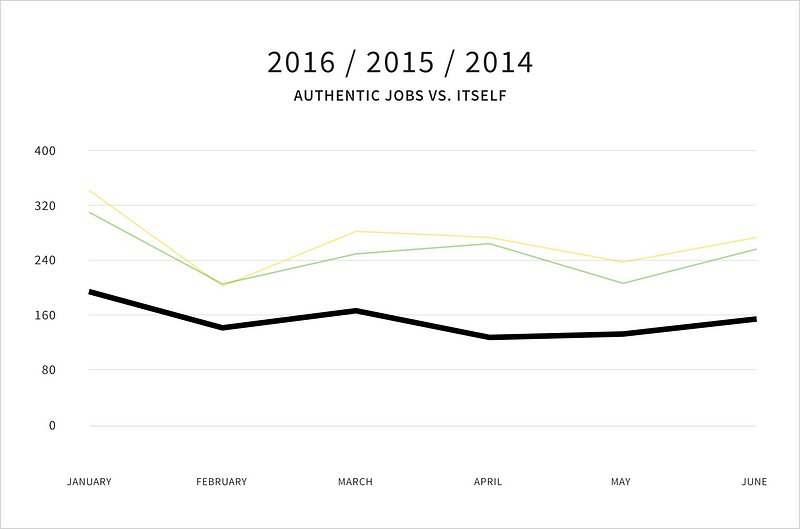
Other thing that should be mentioned: a lot of initiatives at a lot of companies over the last two years just didn't work.
Feels a bit like we are at the tail end of a pretty big macro cycle of tech companies green lighting big initiatives with optimistic mindset and now a few years later the due bill is coming and the bets just didn't pay off.
Maybe a big example would be Twitter: a few years ago they were straight up hoarding engineers; fast forward to now, what did all this amazing engineering talent get them? Maybe nice code but the engineering they've done hasn't been able to increase users.
The reason engineers get paid well is because of their extreme leverage: just a few engineers can pull off amazing results. But you eventually need the results. And if the results are not there, broadly, then there will be a reentrenchmet.